

In This Episode
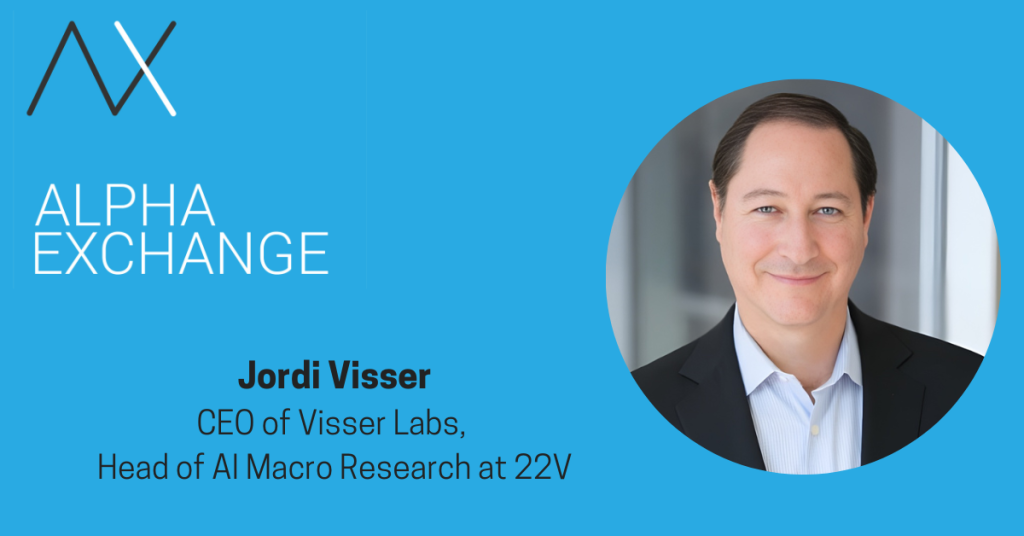
On this episode of the Alpha Exchange, I’m pleased to welcome back Jordi Visser, CEO of Visser Labs and Head of AI Macro Research at 22V. Our conversation centers on one of the most consequential themes in markets today: the intersection of artificial intelligence, exponential innovation, and market structure. With Nvidia’s historic rise as a backdrop and AI’s increasing integration into every sector, Jordi pushes back on the tendency to label this cycle a “bubble,” arguing that AI is more akin to electricity — an enabling technology whose applications will permeate everyday life. Demand for compute remains effectively infinite, he notes, and the supply shortfalls in GPUs, data centers, and power capacity shape how investors should think about the buildout phase.
Jordi also lays out a framework for navigating volatility in sectors tied to AI buildout — including how to handle 20–30% drawdowns — and why estimate revisions matter more than multiple expansion from here. Beyond markets, we explore the labor dynamics of exponential technology: the K-shaped economy, margin pressure at retailers, and why he believes labor participation will keep drifting lower even without mass layoffs.
Finally, we examine the policy environment. Here Jordi asserts that the Fed’s framework is backward looking and misses how humanoids, robotaxis, and accelerated drug discovery may drive deflationary pressures.
I hope you enjoy this episode of the Alpha Exchange, my conversation with Jordi Visser.
Transcript
DownloadDean: Hello, this is Dean Curnutt and welcome to the Alpha Exchange, where we explore topics in financial markets associated with managing risk, generating return, and the deployment of capital in the alternative investment industry. On this episode of the Alpha Exchange, I’m pleased to welcome back Jordi Visser, CEO of Visser Labs and head of AI macro research at 22V. Our conversation centers on one of the most consequential themes in markets today, the intersection of artificial intelligence, exponential innovation and market structure. With Nvidia’s historic rise as a backdrop and AI’s increasing integration into every sector, Jordi pushes back on the tendency to label this cycle a bubble, arguing that AI is more akin to electricity and enabling technology whose applications will permeate everyday life. Demand for compute remains effectively infinite, he notes, and the supply shortfalls in GPUs, data centers and power capacity shape how investors should think about the build out phase. Jordi also lays out a framework for navigating volatility in sectors tied to the AI buildout, including how to handle 20 to 30% drawdowns and why estimate revisions matter more than multiple expansion. From here, beyond markets, we explore the labor dynamics of exponential technology, the K shaped economy, margin pressure at retailers, and why he believes labor force participation will keep drifting lower even without mass layoffs.
Finally, we examine the policy environment. Here, Jordi asserts that the Fed’s framework is backward looking and misses how humanoids, robotaxis and accelerated drug discovery may drive deflationary pressures. I hope you enjoy this episode of the Alpha Exchange. My conversation with Jordi Visser.
My guest today on the Alpha Exchange is Jordi Visser. He is the CEO of Visser Labs, also the head of AI macro research at 22B. Jordi, it is a pleasure to welcome you back to the Alpha Exchange.
Jordi: It’s great to see you Dean. Thanks for having me.
Dean: I will set the stage here. I was just looking inaugural podcast was October 2020 so let’s walk through the world there. I see one similarity and only one which is Donald Trump was still President. The 10 year yielded 73 basis points and then most glaringly and perhaps a launching point for this conversation, is that the market cap of Nvidia was $370 billion. So since you’ve been on Nvidia has added 4.7 ish trillion. It’s been quite a fascinating market. We had a giant tightening cycle in there and big stock bond sell off. But really what I want to focus on, which is clearly a giant focus for you, is AI and the implications for equities. The implications for the labor market and monetary policy. You’ve done so much thinking and also just great writing through your substack. So I think on behalf of everyone that’s reading, you’re making a great contribution to people’s understanding. So that’s fantastic. I would love to start with a piece that I read and reached out to you immediately on, which is this basically taking up the topic of whether AI is a bubble. I don’t love the term because it creates visceral reactions, but of course there’s some exploration there and trying to effectively ask ourselves, are we just way, way ahead of ourselves?
Is there the potential for some giant sell off in these stocks? And what you do in this piece is really by virtue of the history of innovation and invention. You lean into what occurred with Edison and his great creation and how that set the stage for so many things past it. So maybe start there at how you thought about bringing these two things together and then what the history of Thomas Edison’s invention teaches us about what we’re seeing in AI now.
Jordi: Yeah, it’s funny, Dean, because I’ve probably spent the majority of this year trying to get people away from exactly what you said at the beginning, which is when you get into the point of labeling something a bubble, you’re making a very binary statement. And the problem is when people say AI is a bubble, you can say that no revenue nuclear companies are a bubble. You could say the build out is very circular in terms of the payments and that’s an indication of a bubble. But the technology in terms of the innovation itself is not a bubble. And the reason I wrote it and compared it to electricity is because that’s what it is. And I have a hard time having conversations with people that are thinking about it in a very narrow way, which is, well, these companies will never get the revenues from it. And that’s just a stupid statement. A company may never get the revenues. But to fade artificial intelligence and the replacement of labor and the efficiency gains that come from it, we just went through that phase from 27 to 2019, and it just doesn’t get talked about the same way.
AI is not something new. We’re not in the early stages of it. You know as well as I do that whether it’s machine learning, whether it’s supervised learning, whether it’s deep learning, this is all going on during the course of 2007-2020 for our industry world. Quant was born during that time and you had a massive move by all of the large multi strats that effectively spent hundreds of millions of dollars to build out artificial intelligence of some form. So to call it a bubble is just a. It’s a labeling that’s wrong. And the reason I wanted to compare it to electricity was really two purposes. One is if you look around your house and you think about electricity, you don’t touch it, you don’t feel it, but you plug in so many things that didn’t exist before it. So the Thomas Edison thing is he didn’t invent electricity. I mean, we’ve all heard Ben Franklin’s story, we’ve heard everything along the lines. But what he did do with the light bulb is the first application that ended up being huge for allowing us to do other applications and to have washing machines and dryers and everything that’s it plugged in is now an application theoretically on the back.
And so for AI, it is electricity, meaning you’re going to be having it in every single thing you drive, everything you use for your day to day communication. I just literally finished up a conversation with someone highlighting that in the month of November so far, the pharmaceuticals sector is having its best month since 2020 and its second best month since 1999. And the reason is because we’ve had about two weeks of advancements in speculation on drug discovery, we’re going to be curing cancer. How can you have a bubble in something that’s going to cure cancer when everyone’s been affected? So that was the reason for the piece. It was really to get people to think differently. And the substack, I appreciate the kind words. They’re really meant as a reflection for people to think differently about something that’s going to be with us and is in the very, very early stages.
Dean: You’ve got a quote in here in that Edison piece from Jensen Huang. He says, this is the biggest AI infrastructure project in history. We’re literally going to connect intelligence to every application, to every use case, to every device. And we’re just at the beginning and you do some just forward thinking about what that looks like, your dishwasher and your TV set. When you think about this Jensen Huang quote and the promise that comes from this, even if it’s not tomorrow or even five years from now, but we’re sowing this, they’re setting the stage for this kind of stuff. What do you think that looks like in terms of the way we interact with things like appliances?
Jordi: I mean, everything will be communication. First of all, it already technically should be. I mean, I have an Alexa in my apartment just looking to see if she’s going to respond to me saying, but the reality is I use it for a lot of things, but it hasn’t been able, it’s not, not intelligent in the slightest. So your washing machine, your dishwasher, your stove, everything will be verbal, everything will allow you to set things at a particular level. You can give it instructions in terms of when to slow down, when to go. Everything already has a semiconductor in it. Every appliance already has semiconductors in it. Most people that have washing machines, it has a heat sensor. And this will all be done with far more intelligence as opposed to sensors. The easiest kind of technology for people to understand is the car. And just how many semiconductors are already in a car, how many sensors are in a car. But we’re getting to the point with robo taxis, where you have humanoids on wheels, where it’s thinking all the time. If anyone, whoever has been in a Tesla and been in full self driving or any kind of autopilot, it’s amazing when it starts making turns and you’re sitting there for the first time.
So all our lives will change in ways that we can’t possibly comprehend. I started this journey early in the 2000, I guess it was 2013. And so I think for me it’s less about guessing what it’s going to look like. I’ve been reading about all of this way before ChatGPT was launched. That just was the accelerator to me, and that was when the tool came out to speed up and have the network effects. But all the things that you mentioned for people, if they haven’t thought about it, that’s why I can understand why people would call it a bubble, because they just haven’t gone through how much our lives are going to change. They’re going to change in an exponential way over the course of the next not 20 years, the next five years.
Dean: So you had referenced, I think, a podcast you had seen with Gavin Baker on it where he had talked about comparisons to the dot com bubble. The aftermath of that was ugly, but of course sustained benefits with respect to things like the Internet. So a lot of incredible stuff came out of that. But one of the differentiators he had was the idea that I think he said at the height of the bubble, the amount of fiber that was dark was something like 97% of it. And you make the point that really we have supply shortage, a lot of parts of this. I was hoping you could just talk through that. And what part are you thinking about the sustainability of what’s happening here? Is a function of, look, we’re just not even meeting the level of supply that’s given the demand.
Jordi: This is a good question. And for people who’ve either never read any of my work or spoken with me, especially this year, it’s a great opportunity. You probably have 70% of the institutional market that does not believe in AI as an investment theme without it being a bubble, meaning they’re reluctantly involved. They’re more focused on companies like ge, Vernova and Oracle and ones they can physically touch to be involved, that have already had businesses. They don’t want to get involved in any of the outlier situations. But what Gavin Baker said, which I thought was not only really critical but important. So if you take dark fiber and you compare that to ghost cities to start, because I gotta give examples to people of what they’ve already seen, basically you had a build out that used a tremendous amount of debt to get in front of the demand, plain and simple. That’s how you get a bubble. AI is being funded by cash rich companies whose market cap is enormous. And today I got a note from someone saying, are you worried about this debt number? And it showed that, well, it had five companies, including Oracle, and Oracle was the bulk of it, which was the first statistical BS part of it.
Aren’t you worried about this? And I’m like, am I worried that they’ve taken out a hundred billion dollars of debt on a combined market cap of 22 trillion? Nope, not worried. Not worried at all. This is something that goes in with the people who call recession. So since 2000, I guess it was again, 13 was the first time I wrote a paper that was called the Art of Unlearning. And the thing I said to people after a trip to Silicon Valley and Singularity University was the concept of recessions has gone forever. And the reason I said that with certainty was to answer a problem that I had. I thought there was a bubble in Amazon. So in Amazon I couldn’t figure it out. That was the situation where he was building and taking out debt and doing things for the future. And it ended up working. And I needed to go to Silicon Valley to understand why no matter what happened with the name, it had negative earnings, it just continued to march higher. And once I spent time in Singularity University and I learned that first of all it was math, that Moore’s Law was just proceeding as possible and we’d eventually reach a point where we’d need a solution for Moore’s law, hence GPUs.
And we got the solution that we needed. But that changed my entire mindset because I realized that those companies that were growing rapidly, they were not using debt to grow. And that was the first time in capitalism, the first time in 2000 years since people left fields to go because the plow was there that to grow a business, you didn’t need to borrow money. You could actually do it completely out of cash flow. And that’s what changed with Google, that’s what changed with all of the platform companies. And so at that point, I just realized that we were in a completely different world where these companies were going to eat everyone up. The XRT underperformed Amazon for basically the entire decade. That’s the only trade you needed to have on. And I’m just glad I went to Singularity University and I realized that it wasn’t going to happen. So when you bring up the dark GPUs, the demand for GPUs is infinite. And let me say that again, it’s infinite. We don’t have enough GPUs to do all the things that we could do with AI today. The line of demand is infinite. And when people don’t understand that, they need to call me up and just give them one example.
Hey, go use VO3. Can you make a movie with it yet? No. The reason you can’t make a movie with it is because we don’t have enough GPUs. If we had enough to make movies, then there’d be no Hollywood. Immediately you start going through. And I could name hundreds of these examples. The demand side is infinite. It will never not be infinite. What’ll happen is eventually the efficiency will get to a point where we don’t need to use GPUs, we won’t need to use gas turbines, we won’t need to use all of the power needs that we’re hearing, because we’ll come up with novel solutions when we get to AGI, but we’re far away from that, Dean. So for the people out there, the alpha that’s created is the bubble. East, as, as I call them, will eventually push the market lower. And you have to be in a position where you already know your names are going to work. Semiconductors will continue to work over the long haul. You have to be ready for these. Because every time we get a fall in this, which is 20 to 30%, which is the unwind of a bubble, if I ask people, we’re going to have a 30% fall, we have 30% falls all the time.
In Nvidia, we had one this year when they happen, you just need to be in a position that you’re able to buy them at that point.
Dean: So you’ve got a couple things there and I would reframe the question around bubble and throwing one of my own little phrases out there, which is that risk on and risk off are curious cousins. And a stock like Nvidia doesn’t add $4.5 trillion in market cap and not attract a lot of attention and a lot of capital along the way. We know that just indexation is going to be massively long. Nvidia, anyone who overrode it along the way was just incredibly hurt by doing that and is second guessing themselves. So my point is that really good trades do ultimately find some way of getting crowded. They do invite some version of speculation in them. And as a risk manager, I’m curious. So just being long the theme, and I know you’ve got a certain view on Nvidia and Tesla specifically as winners among like the Mag 7. How does one just prepare for things like the 30% drawdown? How should people think about sizing in a asset class that you’re saying you’ve got to be long, but it’s also very volatile along the way? How do you incorporate just the volume part of it?
Jordi: So, so let me do a couple things here because I want to make sure that we expand and double click a little bit on what you said at the beginning with the bubble, because I have a very psychological viewpoint of this. So back in 1999, 2000, we actually went through a bubble. No one was calling it a bubble. And I came back from Brazil from Morgan Stanley. I took over the S&P book and I was managing etf. So I was on top of qflow and the. I forget the IIX and a whole bunch of Internet long, long lost Internet indexes. But I had tons of people at Morgan Stanley that would come up to me and try to convince me that this was going to continue. And I don’t mean junior people. The reason people call this a bubble is because there was one, meaning no one could call it a bubble back then because there was no tech bubble before it. That was the only tech bubble. So the reason people are calling this a tech bubble is because they’ve seen one. The problem is, and part of the answer to your question is that this is not technology.
I literally can’t say this enough. This is literally like a knife to a chef. This is a tool that everyone should be using. It’s a teacher, it plays chess, it is disrupting the drug discovery phase. Very few people talk about it, but one thing I’m heavily focused on is how much people are underestimating the size of the pharma industry will be if you reduce the drug discovery side in both time and price. I wrote a piece which you probably didn’t see last week, which I got a lot of comments on because I was comparing artificial intelligence to QE for the S&P 500 and profit margins. QE was a financial engineering time period where you could borrow money at zero during ZIRP and then go buy back your stock and create earnings per share. Well, now what you can do is you can cut your expenses by 5% and everyone should go realize that cutting your expenses by 5% with operating leverage is far better than getting 5% revenues. The ability to cut expenses and have your revenues be stable ends up having a bigger multiplier on things than it does for qe. And so for everything that goes on in this and everything that people happen, for volatility and for trading these things, I believe that if you think of AI as continuously moving from different stages, I believe we’re going through a new stage right now.
So the build out stage to me should be hedged by people for the next year. I think a lot of the names that I mentioned saw their multiples come up. It’s a hope trade. You’re going to see the multiples come down on those because they built in a lot. You’ve already seen it with Oracle where it gave up that entire massive historic gain back in September. But I think this is going to be a year where it’s not going to just fall straight down for the names that have good earnings. But I think GE, Vernova and Oracle, they’re going to have trouble next year because estimate revisions are coming down. So for people that are trading names, the number one factor for AI going forward across the board is where are you going to have estimate revisions relative to the multiples? Because I think the multiples in the AI names that have been kind of bulletproof this year, and this includes nuclear and these really speculative areas, Quantum, those things to me are honestly garbage. That’s truly something I don’t buy into. I think you can go by pharmaceuticals this year, I think you can go by commodity names this year.
I’m focused on PMIs going higher. Why would PMIs be going higher? It’s an AI trade. We need to do the build out. The problem is the build out we did so far has been focused solely on the big companies that make gas turbines. The utility stocks and these things all have 30 to 50 P Es and they have to grow into. They have to get the earnings to get justify those P Es. And they’re now running into bottlenecks. Core Weave came out with the news item this week which I wrote a paper on that basically they had to take their capex numbers down and they had to reduce guidance. So you’re going to have a lot of this stuff going on. I would focus for people that after these things have a big ride. You know this as well as I do. If your RSI’s get above 90, I’m always much more interested in doing call replacement for the Delta as opposed to buying puts. And that’s the way I’d keep doing it. And then just keep rolling up those calls until you get the big correction, let it fall and it’s going to happen twice a year where you’re going to get 20 to 30% falls in these names.
Dean: If you to look at the S&P back in from 96 to 2000 it became a lot more tech centric. Right? That was certainly a characteristic. And then by 2006 it was a lot more financial centric. It’s got to be record tech tech centric, but really more the AI factor. And so my question is, if I’m an investor that buys into the societal changing implications of this technology and what it can do, the tool and all that you’ve described, am I okay in using the S&P as a proxy for that? Does that have enough of an AI factor built into it along with some varma as well?
Jordi: We’ll start getting into some hot takes of things that you probably haven’t heard me say. I’m very, very skeptical on the magnificent seven being able to benefit from this whole movement. I do think Nvidia should be the one stock that people spend an enormous amount of time on. And the reason I say that is because the stock is dirt cheap relative to the reality of what’s going to happen the next five years. We need a certain amount of gigawatts to supply the demand side of AI. And even though there may be some increased efficiency gains. Because what people should understand is every time there’s a deep seek thing, whoa, you hit efficiency gains. That doesn’t do it. We have efficiency gains. Every chip that he puts out is better than it was more efficient when it was the last one. So we’re having efficiency gains. The demand is infinite and right now we have infinite demand. So we need more compute. They have to build it out. And the problem is, if you build out the amount of gigawatts, you’re talking about a $5 trillion build out. Now 50% approximately of that goes to the compute side and 50% goes to the energy side.
Just to make it simple, Nvidia has a moat right now on the compute side. So if they got every single one of those dollars, it’d be two and a half trillion dollars of revenue. Right now we have a forecast of $420 billion for revenue for Nvidia in 2030. So the stock is dirt cheap relative to their market share and the size of the bit build out. So let’s haircut the build out. Let’s keep the numbers about the same and assume that they lose some market share. The probability of them losing market share in a big way is just very low because no one’s ever completed the amount of clusters and the size and has the scale that they do. So this becomes a very difficult thing on one side for Nvidia to be an issue. The thing that I prefer and where I would focus most of my attention for everyone on the AI side is that I do believe that the Mag 7 are built on code. And this is something important for people to think about. If you ask me why the dollar has been so strong since 1992, I will say because Silicon Valley owned code.
We owned everything built on code. And code started being built and dominating the world in 1992 when Netscape effectively went public or started their IPO. And the reason I remember it, I was at Morgan Stanley at the time, had just gotten there, and it was a big deal for the whole roadshow and everything. That was when we started to dominate. So the dollar strength, the weakness around the globe, all of these things have been related to a moat that the United States has had on the talent and the companies. So when you look at the companies that are run, the CEOs of these companies, they’re not American. Many of them are not. Some of them are, but a lot of them are not. They’re from all over the world. Especially when you go into biotech and you go through this, a lot of the engineers and the people that are responsible for the code, or from Eastern Europe, China, Asia, wherever you want, India, that just means that if we’ve had a dominant moat for a period of time, if the Mag 7 don’t outperform anymore, I think the rest of the world is going to outperform.
And that’s what you’ve seen this year. So in An AI year. You’ve actually seen Brazil outperform, Europe outperform, China outperform, go around the world. I don’t think this is something that is understood by many. I think this is the beginning of a trend where you don’t want to be long the tech sector in the us you want to be long the semiconductor side for right now, but not Software, not the Mag 7 and not a lot of the things there. I’d rather be long the rest of the world versus the US One of.
Dean: The things you talk about is around investment cycle versus the adoption cycle or the benefit cycle. Sometimes there’s a lag and the market is perfectly obviously ready to accommodate some lag. But at some point, perhaps there’s a degree of impatience. You say if the lag is too long, if revenue growth doesn’t materialize fast enough, there could be a capex hangover. What are the signs you would be just paying close attention to for that to become a bigger part of your risk mosaic?
Jordi: We’re nowhere near that side, but it would be related to capex being cut. And that’s why I said core weave is a big deal. They’re not cutting it because of demand, they’re cutting it because of bottlenecks. So it’s a different situation. Okay, so we’ve been investing, I include the Mag 7 and what has happened the last couple years is a software thing. Eventually you need the hardware, which is the data centers, to actually catch up to the brains. So people understand all a data center is, is a gigantic brain. So you’re creating these brains all over the place to be able to provide into the cloud the necessary things for the models. Eventually we’ll get into the brains being in the cars and the brains being in the washing machines and everything else, and that’ll be a different scenario. But the only thing that would convince me that there was a problem is if the capex stuff really started to change and we just had capex raised again. It’s been raised every quarter this year, so that would really be where I’d start to worry.
Dean: Something to watch, but not nearly there yet. Let’s talk about the K shaped economy because so much of what you’re thinking is also around good deflation, but it’s disruptive for sure. There are plenty of charts that Show here’s when ChatGPT was introduced and here’s what’s happened to the S&P versus Jolts. As an example, One of the many examples, Walmart, Kohl’s, McDonald’s, target margin erosion Frame out what you see there so far. And you’ve said that the labor market shock is not even started, which is worrisome but certainly provocative in terms of what we need to think think about, talk to us about the labor side of things. Yeah.
Jordi: And since I highlight this every week in my YouTube video on one side, I think economists are. I’m not a big fan of economists. Let’s leave it at that. They never have predicted a recession. I find the work that they do to be completely backward looking by definition. And they refuse to look at real time indicators like asset prices which discount everything way, way, way in advance over this. And I’ve built my own recession model. So I’ve never, never been a big fan. But when you think about the situation as to labor, they’re actually missing a very big point. The part they should be talking about is what’s been happening to exponential innovation since 2007. The labor participation rate went down violently after 2007. Now we don’t hear about that. And for people who realize when you shrink people participating in labor, so those are people that could be looking for work that are not looking for work. Part of that I can redefine as the I don’t have to work meaning that the decline in it is a lot of people that are making money from exponential innovation. Exponential innovation is great for profit margins because it reduces or makes your business more efficient.
Now the only businesses in the S&P 500 that have truly benefited from that and driven the profit margin margins higher were SaaS companies and obviously the Mag 7 because they didn’t need as many people as say a Ford did or GE did or any of the more infrastructure. So for a lot of those businesses, meaning the industrial manufacturing side, if you go back 20 years, there hasn’t been many people hired in those sectors. Well now what’s starting to happen is because the SaaS companies and the MAG7 are experts in efficiency and adoption of AI. They’re the ones that are starting to be in the position where they don’t need this. The same thing goes for the consulting jobs. The same thing goes for you and I both worked at big banks. I mean how many PhDs and NASA people did we have inside the banks that were generating code for the risk systems? The banks will be having profit margins soar over the course of the next whatever years. That’s why when people start worrying about the market, I’m like yesterday JP Morgan and Goldman Sachs made all time highs. Don’t tell me about bear markets.
When those stocks are making new all time highs, they’ll be going down ahead of time. The profit margins for these companies will continue to go up and it’s at the expense of labor. So the K shape shows up in things like Chipotle and it shows up in McDonald’s and it shows up in Walmart and Target where the bottom end of the economy, they’re not in trouble, they’re not losing their jobs. The problem is you had inflation move higher and they don’t have hope anymore to move up from the place that they are. You have a huge underemployed situation. It’s one of the reasons that the election in New York was something that Joseph Schumpeter predicted a long time ago, which was we will eventually, as capitalism consumes itself and gets too efficient, we will eventually have people wanting freebies and wanting to have socialism. And so you end up in a point where this is all part of the AI trade. And the problem is for economists, they continue to try and refute things like, like that chart that went around with jolts over the S&P. I didn’t actually show that one because I think the more important one is to show it versus earnings per share.
Because if you show it versus earnings per share, you are having a true break in correlation. I also showed adverse temp workers which have gone down. So we have a problem that will continue. I don’t think it’s a serious problem. Meaning I don’t see human beings being completely replaced. Every year that the S&P goes up 15 to 20%, the labor participation rate will go down. We have demographics. So now that immigration is not coming in, we’re losing 300,000 people a year purely to the age differential. And I really do believe that between the age differential, the reduction in labor participation rate, we’ll have an okay labor force. But we’ve lost the corporate ladder. We’ve lost the hope people would ever have to like, I’m going to double my pay over the course of the next three years. You’re stuck in like a UBI world. And that’s the thing I keep saying is you’ve got transfer payments on one end for the people who are retiring, Social Security, Medicare. You have a group of people in the middle, the bulk of the country living paycheck to paycheck, which is like a UBI world. They have a job, they’re making money, they have enough to survive, but they’re living paycheck to paycheck.
And then you have the wealthy people, which is a small percentage of the people in the country, but they consume most of the of the consumption at this point. So we don’t actually have a recession. We just have this horrible feeling economy that is very K shaped and I personally don’t see how we get out of it in the near term. I think in the long term the deflationary pressures of AI will resolve it.
Dean: So if the labor market shock, the severity of it is still to come, even if it’s a positive productivity shock and deflationary in that sense, is there a grand bargain that you think is going to be necessary? You mentioned ubi, just from a forward thinking standpoint, is there some compact that’s going to be new between the government and labor that’s going to be necessary?
Jordi: It’s not going to be new, it’s going to be continuous for people who, again economists don’t show this. So income growth in the US right now is up about four and a half percent. It’s really hard to have a recession when the income is growing by four and a half percent. If you go through the income X transfer payments, so get out of the government handouts, it’s only 1.4%. The transfer payments are 8.8% growth. So the problem is for everyone in the country. Donald Trump just said he was trying to give everyone $2,000 except the wealthy people. This isn’t going to stop. It’s why in the end bitcoin and the crypto world fits into this. It’s why the deflationary pressures eventually went out. So I want to make it clear, since we haven’t spoken about this, I do not believe there will be some massive amounts of job loss over the course of the next few years. What I think will happen is the normal rate of people dropping off is say 25,000amonth. We’ve shut down immigration, we have shortages in various parts of the market. The problem is this is where the underemployed get.
If you have a degree in finance and you have to work at Whole Foods, you’re underemployed and you’re angry and you vote a certain way and you have to call up mommy and daddy if you can and get more money and stuff like that. Unfortunately, that is a lot of the microcosm of what’s happening. And that’s what I expect the next few years. There’s no way humanoids are coming fast enough. Robo taxis could replace 3 million drivers. And I think it will cause a lot of pain for doordash people and for for Uber drivers. But that over three years, I don’t think there’s going to be enough of a full speed ahead. AI is moving so fast that I believe the deflationary pressures will happen faster than the job losses.
Dean: So let’s move on to the monetary policy side of this. I want to see if I could display this here. I’m not sure my acumen will allow it, but let’s just see here. Okay. So this was the dinner we did.
Jordi: Yep.
Dean: Spark Steakhouse. I could use that. Our recession’s over and what we did was, or I replicated a mock press release you did from the FOMC. I thought this was wonderful. January 29, 2029, 2:00pm FOMC decided to lower the target range for the Federal Funds Rate by 50 basis points to 1%. The action reflects the committee’s ongoing assessment of evolving conditions in light of the transformative technological advancements impacting labor and the economy. And then you talk about integrating humanoid labor. The committee recognizes the growing presence of humanoid robots in the workforce and the need to integrate them into traditional economic metrics. And I’ll leave it there. But I thought this was a wonderful way of thinking forward and the types of things that we might just entertain, perhaps not even that outlandish. And so I would love to shift to Tesla, because you had some really interesting thoughts on Tesla. They are clearly focused on the robo taxi, but also the humanoid. That part of things. And having these humanoid bots walk alongside us. You’re bullish on Tesla with the idea that they’re making just tremendous progress on some things. Perhaps the average person doesn’t know a lot about it.
Talk to us about what you see there and the deflationary aspect there.
Jordi: As I do this, I just want to make sure that people have looked at a lot of charts this year of stocks that have gone literally parabolic. I mean, even with Oracle’s fall, I think it’s still up 50% this year or something like that. So the biggest mistake by people is when these parabolic moves happen, they just say it’s a bubble. They’ve missed it. They can’t short it, because if you try to short it, it just runs through you three times. And it’s like, well, once it gets to 70, what’s the difference between 70 and 80 and 90 and 100? And then they start saying, this will end badly. So I think Tesla fits in that camp more so than anything. It’s the closest thing I can say as someone who speaks to people about Bitcoin and Tesla. They’re the exact same thing. People don’t know how to value them, they don’t know how to think of them. But to me, they’re both exponential innovation. Meaning I think five years from now, your comment about humanoids is so critical. But right now, how do you value a humanoid? We’ve seen Optimus. We know that everything is moving ahead in terms of the ability.
I mean, it’s been about three months of just unbelievable videos of what humanoids can do. They’re starting to sell them in people’s homes. You’re starting to get a point now where, okay, humanoids could enter the equation. What I wrote about Tesla over the summertime was that the gateway to humanoids is actually robo taxis. Robo taxis are. They’re humanoids on wheels. If they’re done by Tesla. And for people who don’t know the difference between the way Tesla’s approaching that and the way Waymo at Google is, is very simple. Elon Musk says if you took a Tesla and dropped it on Mars, it could drive around Mars. If you took a Waymo and dropped it on Mars, it could do nothing. And the reason is because the Tesla is thinking for itself. It’s using what it sees and it’s making decisions the way an artificial intelligence would get. Andre Karpathy, who was the original person engineer involved with Tesla on the autopilot side, he recently yesterday actually posted something in X about finally being in the most recent FSD and just said it’s unbelievable. He can’t believe how far ahead now autonomy and this level is. And so my whole thesis on Tesla gets into the fact that robo taxis and humanoids are the biggest TAMS you can think of at this point.
Humanoids arguably are the biggest tan that will happen to replace physical human beings from jobs. Because at the end of the day when we talk about why I don’t think there’ll be massive labor loss, most of the jobs actually still are physical. Until you have Humanoids, you can’t replace a barber. You can go up and down the line a lot of the service jobs. We’re not going to replace doctors now, we’re not going to replace nurses. So you can’t have all of them be knowledge workers. Knowledge workers don’t make up the entire economy, despite what people will tell you. And in particular, you have a lot of knowledge workers outside the U.S. in India, different call centers and things like that happen over time. So Tesla’s an important thing for people to understand that these charts that you’ve seen that once they go parabolic. There’s usually a switching point. The switching point is when people can take the future, that 2029 piece and they have clearer vision on it. So view it as when four years out is no longer something you can’t see on the front screen of your dashboard, but you’re getting close to that end destination.
That’s when the speculation starts. If anything has happened this year, people get far ahead by like three to four years on these trades. And it’s one of the reasons that if people leave with one thing as homework assignment to go forward, spend time on Eli Lilly, spend time on Isomorphic Labs and Google DeepMind. Spend time on Demis Hassabis Nobel Prize and why he got it last year. And then spend time on a little company called Insilico. Ask your chatbot to go in and say, hey, will you connect Eli Lilly to Insilico to Isomorphic Labs and tell me how they’re going to speed up drug discovery as a group? Because they’re all working together and they’re all talking online about how clinical trials on cancer drugs are coming and this is a reality that’s going to happen. And so if you go through GDP and you realize that globally about 10% of all expenditures around the planet planet or on healthcare, and most of that is chronic diseases, you’re talking about a lot of revenues that’ll be shifting a lot of revenues. Remember what Ozempic did to like consumer staples and things. You’re going to have a serious trade on people living longer and having less chronic diseases.
And that’s all going to happen within the next four or five years, just like humanoids. So when you put humanoids, robotaxis and drug discovery all together, Dean, I think rates might actually be a little bit lower when the Fed meets that. Right.
Dean: So let’s talk about the monetary policy side of things. Is the Fed fighting recessions or excess growth with tools that are going to prove to be very outdated? Are they already outdated? And if you were to fast forward and again put that creativity hat on, is there some new mechanism for trying to either speed up or slow down the economy that’s going to be different from traditional Fed policy channel through the short term interest rate?
Jordi: The Fed is a disaster. I saw people say policy mistake in September and all this. I just want you to recognize that the rules of the game have changed. And so if you’re a fan of a football team and you’re trying to win Game 63 in the NFL when they’ve got changed all the rules, where you can basically, you can’t touch the quarterback or the wide receiver. You, you can’t do anything in terms of hitting people. The defensive part of the game has changed dramatically and it’s become an offensive game. We’re in an exponential point, which means that every year is like 10 years in innovation. The Fed is making decisions by definition always backwards. So if change is happening at a fast pace, they literally have no purpose anymore. In my opinion, they have zero purpose. Zero. The only time we’ve had inflation that mattered was when the government put in 8 to 10 trillion dollars in a short amount of time. Of course we had inflation. Now we don’t have inflation right now and we’ve come up with a random measure which is another stupid thing of 2% and everyone marries to it because they said it.
I mean kids, did they really listen to their parents curfews when they wanted to go out at night. I mean this is ridiculous. The whole aspect of going through this when you’ve got humanoids coming forward four years from now. So it wasn’t a joke when I wrote that this is stupid to be focusing on that what I believe they should be focused on. And they’ve started to. I highlighted in my most recent video that in July at the meeting when asked about the impact that AI was having on labor, Powell basically said there’s no impact, we’re not talking about it. In September he started to lean a little bit towards it. Now part of this came from his pivot at Jackson Hole. Something changed where someone made the point with inside the walls to him that the labor market is starting to be disrupted. Now we obviously had massive revisions and we saw zero to negative jobs ex healthcare over the course of the three months beforehand. It’s actually I think been six months that we’ve had negative jobs ex healthcare. Then in the October one he said he’s talked to a lot of company leaders and AI is not only having an impact today, but he’s concerned about what they’re saying about the impact going forward.
Now we’re starting to get into something where at least the change is happening, where they’re starting to pay attention on a forward looking basis to a structural shift. So I would imagine that they’re going to remain on the dovish side, that they are going to err on the side of labor as the deciding factor over inflation. And I think that’s the only thing people should be looking at is if the labor market remains around zero, they are going to cut rates. Rates because we have a K shaped economy. And that’s just the fact.
Dean: One of the insights I came across in doing some reading ahead of this, and I think you were quoting an interview that you had seen just around the way in which cryptocurrency might become a little bit more of a or some portion of the transmission mechanism for monetary policy. Of course, it’s not in any way at this point, but I think you were suggesting that deflationary aspects of this and the need to speed up velocity was going to be significant. Can you talk about that?
Jordi: This is probably too early for this discussion, but I’ll still say it anyway as people think more about stablecoins and just realizing that stablecoins plus AI agent means more transactions and more things happening at a faster pace. Tokenization is a massive inclusion into this. So if people haven’t spent the time time on again, if you didn’t go through the genius act and start to follow crypto, you’re behind the curve. When the Clarity act goes through and tokenization becomes a reality, you have to go spend more time on tokenization because what that does is the illiquid parts of our economy will become liquid very, very quickly. Because that’s going to be the focal point. I think private credit in particular because of all the problems that are happening right now. But let’s just take commercial real estate because we’ve had an issue there that’s gone on since 2023 when Silicon Valley banked. If you want to sell a building right now, it’s 70 to 90% down. You see this every day in the papers. What if there was a fund that any human being could put in small amounts of money and wanted to take a bet on some of these buildings in some of these cities?
It’s much better to have 8 billion people bidding on buildings than it is to have sophisticated 17 people inside a city that are able to buy it. Tokenization is going to provide liquidity. Liquidity, it’s going to allow for more certainty in terms of a bid offer. I want you to think about Kalshi and Poly Markets and I want you to extend it to tokenization. That’s what we’re headed towards. Those are all businesses that are going to get together. So I think people need to realize that transactions will be happening more. We’ve had a money velocity problem for a long time. One of the primary reasons is because of the demographics. Again, older people right now may be trapped in their homes. They might be trapped in illiquid assets. They may have art in the house, they may have anything if they want to take some of that money and give it to their kids or go through it, they’re not going to go sell a piece of art to give money to their kids. But if they could sell a piece of it in tokenization and always have liquidity on these things, it’ll allow for more transactions that’ll bring more velocity.
More velocity in transactions leads to more GDP and less need for both the interest rate side. And I’ll say this, as someone who believes in the future of the digital economy and the capital structure changing in the world. You and I both have a structuring background. I’ve said forever debt will not exist in the future, so the capital structure is going to change over time. The only debt that really exists in the planet right now, we talk about it every day because it’s the governments now that have all of, they’ve issued all of the debt, so it’s disappearing on its own. What’ll happen in the future is everything will change and you’ll have less leverage in the system. And so as someone who believes that what will happen is the fiat assets will eventually converge into the digital economy through the digital assets as Zelle allows remittances to happen, which is going to happen as JP Morgan issues their own coin. These are all massive, massive changes that are about to happen in the industry. I can’t think of anything more important than the financial guardrails being redone by the government and by all this innovation happening.
We are in a post dotcom bubble for crypto. It’s why the altcoins and everything has had such a hard time. You destroyed people. The VC world does not have money to put in and fund these things. And it’s been burned once and you have the competition from AI. But AI and crypto are aligned for more velocity, less leverage. And that’s where these two converge. And it’s something I feel very strongly about.
Dean: Let’s go through that real quick. The commercial real estate, the billion dollar building that’s got a significant debt stack associated with it, it’s got unwelcome refinancing coming up potentially at higher rates, but it’s just vastly illiquid. Like you said, there could be 17 folks that might want to play a role in this and they just might not want to want to refi it or bid on the building. How should we think about the liquidity aspect of that building through tokenization? Just give me a sense as to what that would look like.
Jordi: Let’s use a couple examples. Let me go Back to the cow sheet thing, and let’s assume that 0 to 100%, which would be the binary odds of something. What that represents is, hey, where’s your bid on this? How far down is your bid on this real estate? Are you at 90% down or you’re 10% down? That number is going to take shape based on how many participants are involved in the market and those participants. Obviously, if you have 8 billion people and every 8 billion people are willing to put a dollar into something, all of a sudden you’ve got all this liquidity that wouldn’t exist if Blackstone was the only buyer or KKR was the only buyer or some other place. So eventually, that’s one way to look at it. The other way is to take like GoFundMe or any of these other things that we’ve seen in the past where someone is desperate, they need to raise money. There’s a story associated with it. People have money. There’s a gambling culture. In the way people talk about it now with younger people is they’re gambling. I don’t view it as gambling. And as someone who’s got to know this community more and more, I will take some of the traders that I have met at events over people that have worked for me, people that I’ve seen in the industry, they are sharp, they are on top of things.
And the biggest thing they have is they have the future ahead of them. People in our industry, including me, including you, we’ve made our money. We’re trying to keep it, we’re trying not to lose it. They’re actually trying to make money. People that are trying to make money, especially in tokenization, this is where the fuel is for this stuff. I think for all public companies, all people that have already made their money. When you’re in the K shape to the economy, you have everything to lose. You have very little to gain. So that’s why you make a bid that is so far down, because you see a distressed seller. If you’re someone that has time and you have 20 years, 30 years, I believe New York City’s going to come back. I’ll buy a building down 90%. I know they’re going to turn into something. That land is worth more than that. You want to size up more of that. And I think that’s the way this is going to play out. Next year will be the starting point of it. It’ll start with stocks, but private credit, if people go spend the time, this is a net natural for this.
It’s a natural because right now we have a problem where we’ve got blowups that are happening. And rather than go through the contagion that used to happen, meaning we had this levered private world and it would spread. We need liquidity. And the liquidity used to be the Fed. Well now the liquidity is going to be the artwork, the liquidity is going to be the real estate. Liquidity is going to be everything that you can do. Because if you can sell part of your house in New York City and say oh great, I’ll sell 20% of that and I’ll go buy 20% of this thing that’s collapsing in LA you’ve now diversified your portfolio, you own a little bit of L A maybe because you got a kid out there, it doesn’t really matter. Everything’s going to change that way.
Dean: Yeah, that’s fascinating. I followed the Kalshi stuff very closely. We all think probabilistically that’s really what those are.
Jordi: Exactly.
Dean: Takes us down a journey of price discovery that we on things we’d never seen before. You’d mentioned government debt and this is where I wanted to finish which is when you and I, we met in the pre financial crisis period. We talked a lot about variance swaps struck at 15 on the S&P which could have been bought for a song and cds at 20. And then we talked a lot in the post crash period about China. And you were very early in thinking about what was happening there. We’re in an existential contest here. I’ll just use that gentle word with China, the US government bought a stake in Intel. Maybe that was a little idiosyncratic just given what was happening to that company. But it does feel like there’s an arms race with geopolitical implications and this idea of state capitalism that the US government may need to really shake hands with private industry in a way that we’re just not used to in the past. The stakes are that high. I’d love for you to finish us off just on that broad topic. And how are you thinking about it?
Jordi: Yeah, so it’s probably back in May, the thing you would have read from me and heard was that there was zero chance in my mind, unless China was going to invade Taiwan, that there wouldn’t be a deal between China and the US because China had a huge advantage in rare earth. This is before even I think the government recognized it. This had been known out there for a long time and I’ll give credit to Tolu Groman for talking about it publicly. I was doing It I don’t think enough people really grabbed onto it, but it became evident as we got into November when they shut it down again. But rare earths are needed in everything from a military perspective, everything from an automobile perspective. And China has 90% of the world’s processing. I wrote a paper going all the way back to Deng Xiaoping, literally saying in 1990, this is our oil, this is our geopolitical, our geo macro protection against exactly what they went through this year. So they used it. So there’s two ways in my mind to think about this. On the one side, I really don’t know how else to say this.
Elon Musk is a child, he’s a gamer, he’s an incredibly smart person, but his desire is to colonize Mars. Demis Hassabis wants to cure cancer and cure all disease. Sam Altman I believe is out of his mind and I don’t trust him for anything. If you ask me what he’s in for, I think it’s his ego, his legacy. He wants to be known for owning AI and he really cares about this AGI thing. So I think that’s a scary situation because these are the people telling the government, if you don’t race super fast and make sure we don’t lose this race, we’re all going to die to China. I just don’t believe any of that. But you’ve got nerds, I hate to say, people that were gamers, self proclaimed gamers who’ve got visions that have nothing to do with fighting China, telling them that we need to win this battle and we need to cut them off with chips. It’s a very weird situation. I think it’s great for all of us because it’s going to speed up AI. I will say that my only concern from a tail perspective was that hearing the people from Anduril on podcast, hearing David Sacks, hearing a lot of military people when China had the chance to just basically say there’s no deal, which they still could do.
The US has no ammunitions. We use them up in Ukraine, we use them up in Israel and Iran and they control rare earth so we can’t build anymore. So if they wanted to invade Taiwan, the time is perfect. I mean, Xi said it would happen by 2027. So if people want to tail risk, I still believe an invasion of Taiwan, which most military people tell you is better than 50% chance it’s going to happen by 2030. Most of them say by 2027. I think that’s still a tail risk, but I actually believe that what’s going to happen is this will be a determinant that no one really knows what each other has. The Chinese don’t know if we’ve made advancements in quantum. We don’t know if they’ve made advances in quantum. Quantum is basically a nuclear weapon. The determinant I’ve always believed has kept us from another big war because we just didn’t know what each other had. And I think that’s still still the case. So I’m viewing this in the end as being something we’ll continuously worry about. And I do want to finish on one thing because since you and I are both believers in statistics and probabilities and you made the comment about Kalshi, I want to finish where we started with a very simple thing.
The reason I said that calling AI a bubble makes it very binary. There are so many places on the normal distribution curve where you could put AI, but to make it a bubble makes it binary. It makes it either it is or it isn’t, and that’s just not the case. We have pockets of AI that at times will be in a bubble where retail, which has become a dominant part of the retail structure, will buy call options, create gamma squeezes and go through it and then you’ll get a 50% collapse. Like we’ve seen a lot of these names the last three weeks, but I don’t believe in general that people should go through and make this something it’s not. It is not a cowshe thing, bubble or no bubble. It is literally a normal distribution curve and you have to think of it that way.
Dean: Well Jordy, this has been a fantastic conversation. You give us all a lot to think about, so it’s greatly appreciated.
Jordi: It was great to be here. I appreciate you reaching out. I appreciate the nice comments and love to do it again sometime.
Dean: Awesome You’ve been listening to the Alpha Exchange. If you’ve enjoyed the show, please do tell a friend. And before we leave, I wanted to invite you to drop us some feedback as we aim to utilize these conversations to contribute to the investment community’s understanding of risk. Your input is valuable and provides direction on where we should focus. Please email us at [email protected] thanks again and catch you next time.