

In This Episode
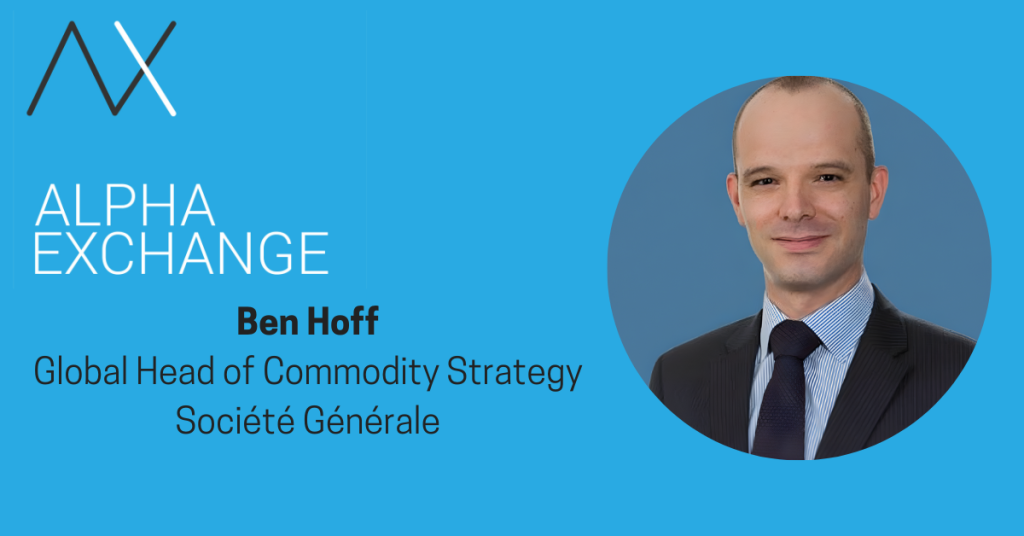
The distribution of asset price returns is a subject of much study in the literature of empirical finance. We know, of course, that equity returns are left-tailed, subject to the occasional violent plunge. But other asset classes are different, and in this context it was a pleasure to welcome Ben Hoff, Global Head of Commodity Strategy at Société Générale, to the Alpha Exchange. Ben describes commodities as a dual system — one that exists both physically and financially. This duality means real-world frictions such as storage, transport, and substitution shape risk and return in ways financial models often miss.
Unlike equities, where the volatility risk premium (VRP) is structural and macro-driven — investors chronically overpay for protection against crashes — the commodity VRP is episodic and micro-driven, emerging only when the physical system’s natural buffers are overwhelmed.
Ben likens the commodity ecosystem to a CDO structure of risk absorption. The first-loss tranche is “optionality in time,” where storage smooths shocks by shifting supply forward. The mezzanine tranche cures through space and form, rerouting flows across geographies or substituting between products. Only when those defenses are depleted does the equity tranche — financial volatility — take over. This hierarchy explains why volatility in commodities is less persistent but often more explosive when it surfaces.
We also explore how the financialization of commodities — benchmark indices, systematic flows, and vol strategies — has created visible “signatures” in pricing, yet the underlying markets remain driven by physical constraints and optionality. Ben’s takeaway: commodities are inherently antifragile, making their risk premia complex, localized, and highly path dependent.
I hope you enjoy this episode of the Alpha Exchange, my conversation with Ben Hoff.
Transcript
DownloadDean: Hello, this is Dean Curnutt and welcome to the Alpha Exchange, where we explore topics in financial markets associated with managing risk, generating return and the deployment of capital in the alternative investment industry.
The distribution of asset price returns is a subject of much study in the literature of empirical finance. We know, of course, that equity returns are left tailed, subject to the occasional violent plunge. But other asset classes are different, and in this context, it was a pleasure to welcome Ben Hoff, global Head of commodity strategy at SocGen, to the alpha Exchange. Ben describes commodities as a dual system, one that exists both physically and financially. This duality means that real world frictions such as storage, transport and substitution shape risk and return in ways that financial models often miss. Unlike equities, where the volum risk premium is structural and macro driven and often leaves investors chronically overpaying for protection against crashes, the commodity VRP is episodic and micro driven, emerging only when the physical system’s natural buffers are overwhelmed. Ben likens the commodity ecosystem to a CDO structure of risk absorption. The first loss tranche is optionality in time, where storage smooths shocks by shifting supply forward. The mezzanine tranche cures through space and form, rerouting flows across geographies or substituting between products. Only when those defenses are depleted does the equity tranche financial volatility take over. This hierarchy explains why volatility in commodities is less persistent but often more explosive when it surfaces.
We also explore how the financialization of commodities, benchmark indices, systematic flows and volume strategies has created visible signatures in pricing. Yet the underlying markets remain driven by physical constraints and optionality. Ben’s takeaway Commodities are inherently antifragile, making their risk premia complex, localized and highly path dependent. I hope you enjoyed this episode of the Alpha Exchange. My conversation with Ben Hoff.
My guest today on the Alpha Exchange is Ben Hoff. He is the head of Commodity Strategy at Soc Chen and someone whose insights are really in demand right now as the right tail of some commodities like gold really kicks in. Ben, it’s a pleasure to welcome you to the Alpha Exchange.
Ben: Dean, thanks so much for having me. Super to be here.
Dean: Going to be a great conversation. There’s so much going on in some of these assets and a big part of our discussion is going to be to differentiate between some of the return attributes, the distributional attributes of assets like commodities versus assets like equities. Let’s get the conversation underway. Learn a little bit about your career background, your shift from academia leading into a role of looking at commodities. Sure.
Ben: So I actually Took my start, as you say, in academia. In my more virtuous days, I was a mathematician and like much of my generation, got swept into finance prior to the GFC and really got my start in rates sitting on an exotics desk at Credit Suisse at the time, which was in many ways very formative for me in terms of my worldview. Now in commodity space, really looking at the asset class very much from a term structure perspective, I spent a little while on the trading side trading commodity index, but really the vast chunk of my career was spent developing systematic strategies predominantly for banks. I did take a little hiatus, left for the buy side just before COVID Spent some time with Point 72 and later with Archery, a commodity trading house, before returning to Soc Chen about two years ago now.
Dean: Well, because this is a derivatives centric podcast and that’s my own background, it’s oftentimes I’m interacting with folks who are coming to markets by way of sometimes a PhD in math or statistics or physics. And of course the Black Scholes equation is some variation of the heat equation. And so you landed on a desk just before the GFC was going to really kick into high gear. And I think as we were talking about on a previous call, the rally in crude into the summer of 2008 was pretty epic. It got us to 145, maybe 147. And what was so interesting as an outsider looking at that market was that volume almost doubled along the way. It probably went from low to mid-20s up to 45, even as the asset was rallying. And then when we crashed, we crashed all the way down to 20. And I asked you this before, but I’d love to hear it again. Just reflecting on what that tells us about whether it’s fragility, the presence of us all in markets themselves. It would be difficult to find a statistical model that accommodated both a 145 level and a 20 level in the course of a matter of months, even under a very, very high volume.
Where does the statistical aspects of markets, where do they begin and then where do they start to break down?
Ben: I think you’ve really put your finger on a historic episode that is, I think, particularly revealing when it comes to commodities really, because within a succession of three months you effectively had a market that went from worrying about stock out risk with crude basically peaking out at, I think, as you said, just maybe just north of $147 in early July of 2008 to a market that ended up bottoming three months later, somewhere in the 20s, basically. Concerned about running out of storage. So those two extreme events really occurring within a very short time period of one another. And I think you’re absolutely right in saying that really shows in many ways the difficulty in coming up with comprehensive, reliable fundamental models which are price relevant from a trading perspective. Not saying fundamental models don’t have their place, but I think coming up with those models is from a trading perspective a really hard thing to do. And it’s precisely because of this type of situation where the fundamentals release frequency might be insufficient, oftentimes is insufficient to really give you the level of granularity that you’re looking for when it comes to price forecasts.
Dean: One part of markets is that they constantly teach us lessons and we’re all looking at data, trying to leverage data. I think we for the most part believe it’s useful to incorporate the time series of what we know already. But that’s just what we know. And I always use the example of perhaps back testing a tail risk Strategy Starting in 2016, let’s say in the VIX you had no idea that 2017 the VIX was going to close below 1052 times. Right. So we only know the data up until that point. And then of course in crude In April of 2020, we saw something that was just so mind boggling in terms of the explosion of volume. There is an oil VIX, I think it’s the OVX and Ben, I think it got to 250 or something like that.
Ben: So that was the 300 actually.
Dean: 300, yeah. So what are the things that you’ve learned along the way where you had to update your framework or incorporate something new in your framework based on whether it’s a risk cycle, a trading strategy, a breakdown in correlation? Just as you sort of reflect back, are there one or two episodes that really stay with you that now are attached to your process that had not been before that period?
Ben: I think negative crude of April 2020, the negative TI it was the May contract that ended up going negative to the tune of I think $37 and change. That’s certainly something that has significantly shaped my thinking. And it’s interesting you mentioned this volume episode in ovx. To me, that’s as much of a true volume risk premium episode as it is a liquidity episode. Because when you look at the app, the monies in the front of the curve, those never got anywhere close to where OVX got to. And the reason is that obviously OVX is modeled from a framework perspective on VIX like methodology so you’re picking up the called one over K squared of wings. And those wingy options ultimately suffered a pretty significant liquidity event through crude going negative in April 2020. So what ended up happening was you had this explosion of ovx, but that explosion wasn’t necessarily something that you could have traded and certainly not traded in size. And it’s interesting because I think volume space kind of highlights and in many ways amplifies a situation that we have much more broadly in commodities. We were just sort of talking gold in the preamble to this recording.
I think there’s amongst finance professionals in general, but certainly amongst non commodity folks this view that everything that has a line on the Bloomberg terminal has the same liquidity as spx. And that is certainly not true when it comes to a whole swath of relatively broadly traded commodities, even markets that are included in the BCOM and the gsci. And I’m just thinking of the softs in particular and taking that to the next level is obviously the VAL space. So not everything that has a print is necessarily tradable and certainly not tradable in size. And I think that April 2020 really, really drove that message home in particular in VAL space.
Dean: Tell us about that specific day if you can recall. And just someone in your seat observing that price action, seeing the prints go down to basically zero and then at least for a short period of time, print negative, there were stories about some of the models that were used not accommodating negative prices. What was that very specific day like? I’m just wondering if you can share from a practitioner’s perspective what that was like.
Ben: Well, I will preamble it with the fact that I was actually on gardening need that day waiting, waiting to start at 0.72. And again, you can sort of pat me on the back here for prime timing, Dean. But you know what I will say is it was actually a fascinating episode and I won’t just put it down to the day of -3750 in May ti, but looking more broadly at that period, you could really see the interplay between liquidity on the one hand, fundamentals on the other hand, and just kind of technically based trend trading all flowing together. And I say that very much when we look at how we got into this situation. I mean there was very clearly a strong fundamental backing for a massive downturn in crude prices, which is the fact that pretty much in the course of eight weeks we lost on the order of 20 to 25 million barrels of crude demand due to Lockdowns, global lockdowns. And we then entered March in this period where everyone was focused on OPEC fixing it, OPEC fixing it. And the outcome of that early March OPEC meeting was basically one where Russia said, no, we’re just not going to cut to the extent that Saudi are asking us to cut.
And Saudi’s response was, well okay, fine, if you don’t, then we are going to just flood the market until you do. And that is exactly what happened. So they ended up pushing into a market that had arguably at that time already lost 20 million barrels of demand. They ended up producing an incremental 2, 2 and a half million barrels extra, lifted their production from low 9 millions to somewhere in the 11 million barrel range on the Saudi side. And that ultimately obviously provided the backdrop to what ended up being this mass of build in storage in particular in the us where you’ve got this landlocked contract, the WTI contract that clears in Kuching, where there is no easy egress that you can just sort of come up with the same way as you can for Brent. And that sort of really set the stage. Now what is interesting is that May contract had already rolled out of the indices at the time that it cleared -37, I think 52. So it was really not on massive volume. But nonetheless, I mean, as you say, it took a while to get there and there was a point where we crossed zero.
So I think everyone did see this coming and I think certainly the financials, the index community in particular, where there is significant AUM that has to roll through the front of the curve, had to accommodate this and did so very cognizant of the fact that the mechanics of how indices operate, the mechanics of how USO operates, those are all massively perturbed and indeed in some cases can be rendered invalid when you have negative prices, in particular when you put leverage on top of that. So I think this is something that the market kind of had to scramble to really provide ad hoc solutions to in the event. But on the flip side, I think when I look at how that was handled, I think lessons were learned that have now basically affected the roll procedure going forward. And that’s probably a good thing. It’s back to your point. The thing is it’s difficult to preview what could possibly happen. And like so many things, we ultimately need bad things to happen in order to adapt. And that’s sort of where this whole notion, I guess, of anti fragility that you know, you and I were also talking about comes in A little bit.
Dean: In the textbooks, the beautiful continuous time models, there’s a buyer and seller at every price in infinite size that markets. Yes, clearing prices are. They’re not discovered, they just exist at every point in time. And if you think about most volume events, there’s some version of a choke point there. It’s a short squeeze, it’s a delivery problem. You’ve done a lot of writing on that aspect of the commodity markets, and I want to get to that next. And as a starting point for that, I’m curious about the return to owning commodities. And I know commodities is a lot of things, but there’s an equity risk premium, right? We’re going to talk a lot about Volus premiums across commodities. And there’s a Volus premium in equities. There is also an equity risk premium. You’re getting paid effectively more than you ought to, at least in the back test relative to the volume you’re taking on. There is a default risk premium, right? You get paid more to hoover up some extra basis points on credit spreads than you otherwise should relative to the incidence of defaults. So there’s some premium there that you’re taking it on, not talking about volume, but just in commodities.
Is there a concept of a structural premium for engaging with the market as there is in, let’s say, equities?
Ben: Yeah, I think that’s a really interesting question and one that certainly provided me with ample thinking material over the past couple of months as I was digging into commodity volume risk premiums. What I sort of ended up realizing, Dean, is I think one of the major distinguishing facts of commodities as compared to other asset classes, other financialized asset classes, is the fact that you have a duality between the physical market on the one hand and paper markets on the other hand. And that duality is by design. Commodity futures markets ultimately don’t exist to keep financial market participants happy. They have a structural reason of existence, and that is that there are folks for whom the price risk of a barrel of oil. You look at a barrel of oil, you’re talking 30 to 50 bull realized, for whom that price risk is just too large to bear on their balance sheet. So what commodity futures allow is to transfer that price risk from an outright price risk into a term structure price risk. So you’ve got the physical exposure of a barrel of crude that you may be carrying as inventory, and you short futures against it.
So now what you’ve created, at least implicitly, is a time spread. You long the front in the form of spot, and you short Some deferred point along the term structure. Now in doing that, what futures markets have allowed you to do is take your 30 to 40, 50 Vol native asset and drop its volatility by an order of magnitude. So spread the time spread that you have long spot short futures ends up basically clocking in somewhere around a 10 volume plus minus. Depends on where on the term structure you are. That is the economic relevance that these markets have and that is intimately linked to making the commodity trade, the process of commodity production and consumption. Something that folks involved in the physical business can manage. Now what’s interesting, and I think this is where things come full circle with the commodity volume market is the fact that physical systems are the real world systems. It’s all about moving barrels from A to B, making sure that you and I have the ability to fill up our cars at the gas station, that there’s gas available. And that all basically means the physical system has a significant amount of optionality, physical optionality already embedded into it.
So what ends up happening is that the financial market is in some ways the signal to summoning or pushing out in time this physical optionality. So what ends up happening, and I think this is where the tie comes in or the comparison comes in with the equity volume risk premium where you’ve basically just got a structural reason why people typically like to bid put volume every once long. And the major, the major concern is what happens if the market crashes. You don’t have that in commodities to the same extent. It’s a question of which commodity, it’s a question of which period in time. So you end up in this issue where there’s in the absence of a structural Volus premium. Yes, you do have an idiosyncratic and episodic Volus premium, but it’s certainly not the same as what you have in equities. And the reason is because the physical system is in a position through the embedded optionality actually fix for a lot of the quote unquote, what can go wrongs that you don’t have in other financial markets.
Dean: It’s really quite fascinating. Again, as an outsider who knows a little bit, but just looking at how sophisticated these delivery systems are and the shape of the curve is, there’s some implicit comment on optionality just from the shape of the curve. And I don’t mean the volume curve, I mean the time curve. Would it be fair to say that a highly inverted curve is very likely associated with a higher volume market? It’s like a yield curve, right? The yield curve inverts and That’s a pretty strong indication that the Fed’s had to do something pretty aggressive. It means that change is coming and the market’s trying to digest it. Talk to us just like if we were to go look at some recent sizable inversions of, let’s say, the crude curve, what can you tell us about the economic conditions on the ground, how that curve materialized? What’s the read through on it?
Ben: Yeah, I think you are absolutely right that higher volume environments do correspond to what we like to call backward data curves, very backwardated curves in commodities. So curves where the front of the term structure is at a massive premium to the back of the term structure. What I will say though is that I wouldn’t go as far as saying that a very backwardated curve structure is necessarily a good predictor of what future realized or future implied is going to be. So what I would say, Dean, and I think this is quite interesting because it ties back to another type of risk premium, which is the carry risk premier. That is highly proliferant, probably the most proliferant risk premium that we have in commodity space, which basically arises as an expression of the market’s fear of a stock out occurring. So let me explain to you briefly what I mean by that. So typically the normal state of a commodity curve is to be in carry. So where the back of the term structure prices at a premium to the front of the term structure, which makes perfect sense. There’s obviously a true hard arbitrage there.
If you’ve got the physical ability to store a commodity and you’ve got the credit available to finance the commodity, you can buy that commodity today, put it in storage, insure it, pay your financing costs, and then go sell it at a cost in the future that covers all the costs that you’ve incurred. And that would probably typically mean that there’s the batch should price at a premium. Now what typically happens is that term structures and commodities have a level of convexity to them where if you were to extrapolate forward the cost of carrying, the front price is just a touch richer than it should. And why is that? Well, one relatively intuitive economic explanation is that if, for instance, a crude oil refiner holding futures contracts doesn’t really help you in running your operation, the only thing that helps you is owning barrels of crude. So owning barrels of crude two months from now is probably a little bit more valuable to you than owning barrels of crude six months from now or 12 months from now, because you can actually use those barrels two months from now to run your refinery even if some form of supply disruption occurs, you can still hold them in inventory.
So in short, this fear of stocking out, maybe because there’s some form of supply disruption associated with straits and Hormuz, that would be the crude scenario. Maybe because there’s an unseasonally cold winter in the U.S. in U.S. northeast or for gas, for corn and for wheat, for the grains that there’s some kind of drought. Eventually these types of events ultimately lead to a slight premium in the front of the term structure. And that premium obviously evaporates away if the event doesn’t happen, that is if markets normally function. So being short front time spreads is a very well understood risk premium that we have in commodities that is ultimately strongly related to this, if you like. The fear factor that in other asset classes would get expressed exclusively through volume.
Dean: Have you looked at it reminds me perhaps of the FX forwards and high carry currencies versus lower carry currencies. And effectively you are making money on that most of the time. But in classic short volume fashion you can get nicked pretty good. And I’m just wondering to me seems like commodity carry through that term structure, that futures term structure is similar to that. You’re extracting a yield from the market in relatively hedged fashion, but you’re short disruption in some ways, you’re short some substantial repricing. Is that characteristic a good way to describe it for yourself?
Ben: I think that’s spot on. That’s why I referred to it as the stock out risk premium. The thing that you’re paying the premium for is the occurrence of the stock out. And when that doesn’t occur, you end up collecting the premium. But when it does occur, and history is littered with examples of this, then obviously could get destroyed on a particular time spread. And gas I think is a fantastic example of how that can happen. In particular towards the end of winter, typically in the March, April, March, May contract we saw the drought of 2012, you had precisely the same type of event occurring in corn, this time in the July Dec contract. You have obviously in energy markets similar type of risks that are oftentimes much more geopolitically linked. So the point here is, typically you wouldn’t trade any one of these from a systematic perspective on its own. Instead you would diversify across every possible market that you can. And then of course you’re in this position where diversification becomes your best friend. Because in commodities, and I like to always say this few asset classes where you can really say it’s the correlation by causation.
But in Commodities, and particularly in commodity carry, it really is because the truth of the matter is a geopolitical event disrupting flows through the Straits of Hormuz is causally unrelated to a weather event happening in the American North American winter, which in turn is causally uncorrelated to a weather event happening in the North American summer. So you do have a certain level of confidence that you are benefiting from the correlation by causation in commodities, probably more so than in other asset classes.
Dean: Yeah, it’s interesting. I’ve certainly done some work on looking at the correlation, let’s say, of volume in credit and in equity. They’re pretty correlated. You get a big risk off the VIX is going to pop and so is implied credit volume less correlated to commodities. You can get more diversification in trying to harvest risk premium across a wide swath of commodities. And a lot of what you write about is that they’re much more episodic than structural. I want to talk about this concept of antifragility and commodities as you frame it. And I’m just going to read back to you a little bit of what you wrote because I thought it’s just so well crafted. So first you say that the underpinning of this idea of antifragility comes through time, space and form. And you say inventories are optionality in time. I think that’s a really interesting. The way you frame it there is very interesting. And then you go on to say that infrastructure and flows are optionality in space. And those are kind of the first two layers of protection in some ways of absorption. Can you dive into that, explain exactly where you’re going there?
Ben: Yeah, absolutely. So when you think about inventories as being optionality in time, really that comes very much from the economic role that the forward curve plays. And we were just talking about the type of cash and carry economics that allows you to move supply to a different point in time. Particular when you take the great financial crisis. I remember sitting at the desk effectively seeing crude go into contango and then going into super contango. And basically what that market was pricing is the marginal cost of storage. And as that storage started moving from being tank based on land storage to being maritime storage, where basically the game became, well, let’s just go out and hire a VLCC that’s sitting somewhere in Singapore harbor, that marginal cost kept on getting higher and higher and that’s what the curve ended up pricing. So what you were doing is basically taking these barrels that no one needed at that point in Time putting them in storage and making them potentially available for consumption at some future point in time. So there you’ve got your optionality in time. And this is something that is massively proliferant pretty much in all commodity markets.
I’ll take power out of that, say for now, just because it is still a little bit more complicated to store. I think we’re making some technological progress there. Who knows, if we have this conversation again two, three years from now, maybe I won’t be taking power out. But broadly speaking, doesn’t matter. Whether you’re looking at metals, crude oil grains, every one of these markets has some form of storage embedded in the supply chain. And that storage gets either summoned or deferred through the pricing of the term structure. So that’s level one. And there’s so many events that have to do with that that it’s almost impossible to enumerate them. Or the physical market basically solves for that, summons that storage all the time when it’s needed. So then the second level is really this idea of being able to move product through different geographies. So that’s optionality and space. And again, crude oil is a pretty good example of this. Starting in 2023, WTI became part of the dated Brent product stream. So you can basically at this point deliver a barrel of WTI from the US into the Brent contract. And that’s just a function of do the economics permit it or don’t they permit it?
You’ve kind of got a whole bunch of different potential examples there of optionality that are really inherent to how the physical market is handling current supply demand fundamentals that you don’t have in other asset classes.
Dean: So this will lead us into your recent work on the concept of a volume risk premium in commodities. And you’ve got this really great analogy to a CDO and how that’s kind of stacked up with the bottom tranches. The first loss or first absorbing tranches being this concept of time, space and form. So we haven’t really gotten to options yet, but we’ve got some risk bearing absorption capacity on the lower part. Walk us through how you developed this CDO analogy. Explain it better than I did, and then we’ll move on and start to talk a little bit about what you learned by studying the commodity vrp.
Ben: You’re setting the bar high there. I think you’ve summed it up very well in a nutshell there, Dean. But look, the basic idea is to say, look, you’ve got this interaction in commodity markets between the physical world Optionality in the physical world and optionality in the financial world. And we just talked about time optionality basically being something that we need all the time because they are always, invariably in any production process, mismatches between supply, micro mismatches between supply and demand. And that’s sort of the base level of your pyramid. Layer one is something we handle every day. It’s completely normal and there’s nothing really out of the ordinary about it. So then comes the mezzanine layer. And I’m really borrowing language from credit space here, from CDO space. So the mezzanine layer is where you effectively have to some extent exhausted the optionality that’s embedded in being able to move quote unquote stuff through time. And so then what you left with is kind of events where you need to either incentivize the summoning of space optionality we talked about in the case of gasoline markets, or for that matter, optionality and form where corn and wheat can become substitutes, provided that the corn price per protein content is high enough to justify substitution interests.
So that’s sort of where level number two, the mezzanine tranche and then the equity piece to stay within the CDO language is really where everything has gone haywire. The physical system is exhausted, there is no more substitution. And at this point your only fix is really price, where price ultimately either needs to destroy demand. On the one side, I think cocoa is a fantastic example of this. There are no substitutes to cocoa. So ultimately there has to just come a point where price fixes. Or on the other hand, it needs to destroy supply, which is sort of what we witnessed during COVID and also what we witnessed during the gfc. So it’s that level really where the physical system has run out of answers for you. There is no more physical optionality that can solve. There’s no more physical optionality that can be summoned. And it’s really that piece where the financial optionality provides the only remaining answer to someone who is looking for some form of protection against these types of events. And that’s really the informant, the how I inform my view of the commodity volume premium.
Dean: If we look at the equity volume risk premium, let’s just sayS&P, we’ll just use VIX versus subsequently realized volume. The characteristic over that over a long period of time is that there is a premium. So you can, with reasonable consistency, pick up those nickels. Of course the danger is they’re just nickels. And when you lose, you could lose in a hurry. But over time, even when you lose you can make it back if you stay in that market. And if you sold the VIX at 15 and it realized 25, well, you’re probably going to get a chance to sell it at 25 now. And of course the challenge is sizing and staying in the game, staying consistent. As you study the characteristics of the commodity VRP versus what I just described broadly on theS&P side. What’s similar? What’s different?
Ben: I think there are actually probably more differences than there’s similarities. And let me just kind of explain this from a structural perspective. So the one thing that I think particularly folks who come a little bit more from an equity background oftentimes get surprised about in commodities, which is obviously very much our bread and butter, is the fact that commodities don’t have a place in the capital structure. So you end up in this situation, and we talked about this before, when you look at SPX volume, well, basically first of all, you’re looking at index volume, we can talk more about that. But that’s different to single name and certainly different to single commodity volume. But secondly, and I think this is important, equities all live in the same part of the capital structure. When you look at how equities get valued, well, they basically from a fundamental perspective, and you can correct me if this is just the silly commodity guy talking about things he doesn’t really understand that well, but they will basically get valued off the PV of their future cash flows. Whereas in commodities, name any commodity, almost by definition there are no future cash flows.
The only thing there is is whatever the commodity right here, right now is. So the reason this is relevant is that you end up in the situation where just because every equity ends up being subject to revaluation of its future cash flows, and that revaluation risk is ultimately largely macro linked. You think about credit deterioration, but mainly rates repricing, inflation repricing, it all affects equities in a homogenous way. You can’t say the same thing about commodities. So you end up having a very different story from a macro perspective for gold than you have for wti. You end up having a very different story for corn to what you have for either one of those. So the homogeneity in terms of response to exogenous risks, predominantly macro risks, is something that you just do not have in commodities. And that’s something that I think is quite important when it comes to understanding structural difference in volatility risk. Female. Now the way that oftentimes gets filtered through is obviously in the type of investor Base. I think one important thing is that basically the big fear in equities, and we talked about this briefly, is it’s all basically about the left tail.
That is where the concern lies because everyone’s long. So that left tail is going to always have a structural bid. Now in commodities you just don’t have that. When you look at where can a structural risk premium come from? Well, from a market composition perspective, of course you’ve got financials in commodity markets, but financials, they can come and leave the markets and it’s not going to massively change the world. That’s not who these markets were designed for. They have an episodic and potentially thematic interest. And if it’s not that, it’s a technical interest. So the ones that are left are really those who these markets were designed for, which is producers and consumers, those who have real skin in the game. And when you look at the risk profile of a producer, well of course a producer typically has the kind of hockey stick type payoff that you expect from a call option holder. And indeed when you look at the business case as a function of the price of a commodity, you look at a crude producer, well, of course that’s the business case. The marginal cost of production is what ultimately defines the barrier between profitability and loss.
And the producer has the ability to regulate down their production as they start crossing from to below their marginal cost of production so they can cap their downside. And to some extent the more limited extent they have the ability to increase production as the price of crude exceeds their cost of production. I say limited because that assumes spare capacity and spare capacity isn’t free. So most producers like keeping that somewhat contained. Now the problem is one might think, hey, well that’s a fantastic source of structural optionality. Why don’t these producers will just go in and sell cores all the time, monetize their upside. The problem is of course that that ultimately caps the equity story and in the end that’s the story that matters. So that’s, as a structural phenomenon, that’s not something that typically gets exploited, certainly not by publicly traded companies. So then you look at it and really the concern for the producers, well what happens in the left tail, because that’s existential. The fear for the producer is really what happens in a scenario where I’ve got collapsing prices and collapsing demand, where I basically end up by force selling less or less.
And at the same time I still have to pay the banks for my loans because I am running a relatively capital intensive operation. There’s Only so much that I can do in terms of cutting drilling crews before production just drops to zero. I have all these fixed costs that need to be met. So that’s where the existentiality lies. And that existentiality indeed. You can very much argue that there’s cause for structural put buying, but it’s episodic, right? Because when crude is at a hundred dollars and your marginal cost of production is $60, you’re not really going to be that interested and excited about dishing out premium for an event which you legitimately think you might still be far away from. You’re going to be much more willing to do that when crude hits 70 bucks. So that’s sort of where the episodic nature comes from. You look at the other side of that market, the other side of the guys who actually have stake in the game, the consumers. Well, truth of the matter is a consumer, the business model is effectively a margin model. The exogenous piece is volume. The consumer does not control volume.
Really. When you think about refinery, basically an independent refinery is going to produce according to what the heating and driving demand, the fuel demand is that. And they don’t control that directly. What they do control is their margin. So yes, you have very much more muted convexity that oftentimes looks sigma soil almost in the price of the refined product. But as we know, the more muted your convexity profile is, the more volatile your underlier needs to be in terms of actually generating a significant premium. And that’s just something that you don’t have. Because the real underlayer here is not price, it’s volume. And volume has a much, much lower volatility than price.
Dean: If we think about just broadly the idea of trying to earn excess returns, that’s really what it’s all about. That’s alpha, some version of getting paid more than you ought to for a given amount of risk. And in some ways that’s providing capital into a market that’s short of it. I’ll go back to again, this is basically where you started 2006. Buffett comes in and he sells, I think it was $38 billion notional of 10 year out of the money puts on theS&P Euro stocks and Nikkei. No one would do that trade. No one has the mark to market wherewithal to bear that kind of Vega risk. It was just an enormous trade and he just marked it to his own liking. He was a AAA counterparty, so he could bear the risk. When you look at commodities, maybe market by market, are there any of Those structural features where you’re getting paid a handsome risk premium for providing some version of capital bearing some kind of convexity or tail risk that is embedded in the frictions of the market, you’re effectively solving a market friction and getting paid excess return in the process.
How does that look in some of the commodity markets?
Ben: Yeah, look, you’re absolutely right. And that is certainly in many ways one of the reasons banks have been involved in this space. Not just from a lending capacity, but also in terms of how producers and consumers are aff terms of selling more sophisticated hedge solutions to consumers and producers. One relatively well known structure that comes to mind is the swing option where when you look at a producer, basically the crucial issue for the producer is that they produce every day. They might produce different volume amounts every day. And when you look at what’s available to them in the listed market, that optionality is always price linked, not volume linked. So being able to effectively take that type of risk profile that a producer would be looking to hedge and translate that into listed options or somehow diffuse that risk and still be able to provide what those types of counterparts are really looking for, that’s really where banks in many ways have been able to add value in this space. And it is really very much what you say. You’ve got a market that is de facto either lacking the liquidity or to some level incomplete in the exchange space where banks are stepping in as intermediaries and translating that risk and warehousing the aspects of it which might be impossible to offset and basically collecting fees to do so.
Dean: A big part of the difference in commodities again let’s say versus equities or perhaps corporate credit is just the nature of the distribution of the underlying returns. Equities very left tailed. You make the point, you say when fat tails realize in the same direction. The result is a structural VRP that’s really much more like theS&P and in assets. Could be crude, could be wheat. It’s certainly gold these days where the asset is being jolted upwards and VOL is going up in the process. I mean today we’re having this discussion on Thursday it’s another 2%, almost 2% up move in the GLD. The gold VIX the GBZ was up an enormous amount today. Just love to hear maybe just running with gold and what you see in that market. It feels to me like a lot of outright accounts have decided that this thing’s going to keep going and gotten the volume community rather short volume. That’s just how the market feels to me this Gold VIX is probably 15vols over realized right now. It’s a pretty big, it’s a pretty healthy spread. It just tells me almost that the market’s having trouble meeting the demand for optionality.
I can’t prove that out, but that’s just my sneaking suspicion. But tell us, when you look at the overall picture, let’s just say in gold, what do you see there?
Ben: Yeah, well, I mean look, it’s the big picture in gold where the question is really where are we headed? I think that’s the fact that basically since mid August to Now, so over two months we’ve seen in excess of a 25% move up without really any fundamental slash economic catalyst. Immediate catalyst really is very telling. And I think that’s in, in part why we’re seeing some of these moves obviously trickling through to VAL space as well. But I think gold is somewhat unique, not entirely unique, but falls into the somewhat more unique commodity category where there is actually a relative dearth of fundamental information that can act as a circuit breaker to reset things. So what happens is you end up with these longer term self referential price moves and they just become reinforcing. So you end up with this question and again I sort of put this out somewhat provocatively in the introduction that it’s very difficult to actually find a tradable fundamental model that is consistently reliable. And I think gold is no exception here. There’s obviously a very strong technical trade unfolding right now and I think we all understand what the bigger structural drivers of it are.
The debasement of the dollar, the fact that central banks since Russia, Ukraine, non OECD central banks have really been more significant gold buyers. These are all structural phenomena that arguably have long legs left in them and that is fueling what is de facto a very technical trade certainly in my view at this point.
Dean: One comment you make here again distinguishing equities, theS&P versus physical goods. You comment the risks come from local supply and demand quirks. So I can imagine again, within this vast space called commodities, there are those for which the generation of volume can be very, very micro. It’s very idiosyncratic. It’s a weather report, a crop report, and then there are others for whom, and you do this principal component analysis. I assume that something like oil is going to pick up a broader array of more macro variables than let’s say wheat tied to inflation or the economy. Just curious, if you could just talk a little bit more about your work in disentangling the drivers of the behavior of commodities.
Ben: Yeah, no, absolutely. Look, I think the one thing that I will say is you touched on this briefly in the intro is that the past 25 years have obviously seen a massive financialization of the asset class. And the way everything really gets tied together is really through these benchmark allocations in BCom and GSCI, potentially in other commodity indices where you just have broad based, typically macro derived flows, where you’ve got real money accounts that are concerned about unexpected inflation ticking higher. That basically is what ties it all together. Now, once you start peeling back that layer of the onion, you end up in the situation where indeed the level of macro dependence waxes and wanes across these different markets. And quite rightly you can ask the question, well, whether the Fed changes its stance and rates or inflation ticks higher, does that necessarily mean that people are going to consume more or less grain? And the answer is almost certainly not. You can end up with a situation where the crude piece ends up bearing a much broader dependence on macro. And that’s something that of course you can see very much in the way the principal components of a PCA are loaded in their first principal component, the fact that the energy complex is just much more dominant than the softs and the grains, that sticks very much to that.
So you see that reflected to a point. Now there’s obviously a difference here, and I think this is where it always gets interesting. How do you trade that? Because running a PCA always involves looking back over a certain number of return days and being able to tell what was going on over the past 100 return days is not necessarily in any way predictive what’s going to happen for the next 100 return days. So I always look at that as kind of an interesting way of reading the tea leaves. But there’s obviously always the cautionary tell of just because we’ve been in all of the macro driven environment, does that mean we’re going to continue to be in a macro driven environment? So as a regime classifier, maybe a little bit more complicated to use.
Dean: Well, you mentioned financialization. It’s a really interesting concept. Certainly in the equity derivatives ecosystem, the trades themselves can sometimes overwhelm the price. They make their way into pricing. There was this VIX ETP blowup in February 18th that was presaged by just a giant piling in to being short the VIX in 2017. And the more it worked, the bigger the trade got, sowed the seeds of its own demise. And then forgetting even about volume, we’ve got this index in the US called TheS&P, it’s the best benchmark the world has ever seen. I mean it’s impossible to beat and the risk of straying from it because it’s so top heavy and those top heavy stocks are so wickedly good in terms of returns. Your risk of straying even a little bit is business risk. How does that financialization in the commodities realm just tell us a little bit about the risk taking aspects or how the financialization might be making its way into the clearing prices?
Ben: I think it’s actually a really good point there. So the way it makes its way in is that the moment you put a benchmark into a market that’s potentially less liquid and this is true for commodity flat price benchmarks, but it’s also true for the various risk premia type trades we have in volume space. You obviously going to create a signature, raw signature in the case of benchmarks, placement signature in terms of where on the surface you’re buying and selling for volume. And in an asset class, when I look at commodity volume, you’ve got a much, much higher node density than you have in equities. And that obviously is to some extent playing out against the backdrop of markets. Even when you look at crude that are just a couple of orders smaller in terms of magnitude. Certainly when it comes to volume, what I mean by node density is really a point. Every node is effectively a point in strike tennis space. And by design, even in the grains you have these serial options which are monthly options on an underlying futures strip which is potentially quarterly or has larger gaps in it. It’s adjusted to really meet producers and consumers.
So what ends up happening is that liquidity for one is just more broadly dispersed across more strikes. So when you end up with a financialized benchmark being fed into the system, the potential of a role signature manifesting is just that much higher. There’s various types of liquidity trades within the commodity volume, but mainly flat price. A space that tried to take advantage of that.
Dean: Well, let’s close out what has been a really interesting conversation. I feel like we could go for another hour. I really like your work. I learned a lot reviewing your work. What’s on the research docket for you? What are one or two things that you and your team are in the early stages of looking at that’s got you kind of fired up and holds promise?
Ben: Well, I’m super excited about all things volve. This is a really interesting space precisely because it’s not the same as what most systematic investors know from equities, say in particular, we’re really exploring systematic term structure across a variety of different markets, reflecting very much our belief that commodities are term structure asset class. And why shouldn’t that be carrying through to volume? That’s one big thing. The other big thing we’re looking at is entropy, and entropy really as a measure of investability of signals within the flat price universe. So between those two things, really have my hands full here and I hope we’ll be speaking again about some of the things that drop out of those fantastic.
Dean: Well Ben, it’s been great to have this conversation. I really enjoyed it and keep up the really interesting work. Like I said, I learned a lot reading your piece.
Ben: Thanks so much, Dean. Thank you for having me. Excellent.
Dean: You’ve been listening to the Alpha Exchange. If you’ve enjoyed the show, please do tell a friend. And before we leave, I wanted to invite you to drop us some feedback as we aim to utilize these conversations to contribute to the investment community community’s understanding of risk. Your input is valuable and provides direction on where we should focus.
Please email us at [email protected] Thanks again and catch you next time.