

In This Episode
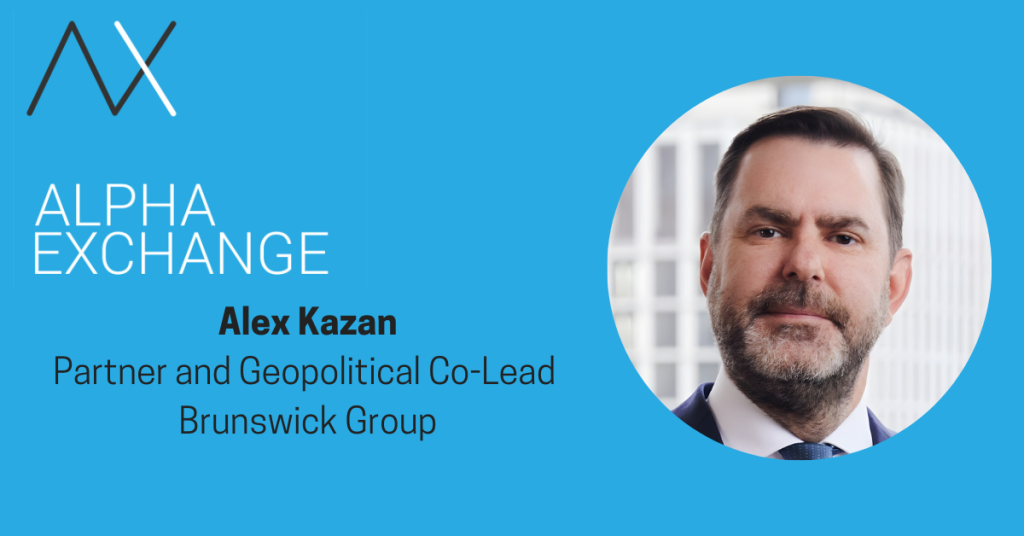
The global economic and geopolitical order has long been balanced by the United States. Today, however, that traditional stabilizing role is in flux. The drivers of market uncertainty, typically resulting from changes in monetary policy and the economy, are increasingly linked to US politics. Fiscal strain, tariffs, and hyper-partisanship are sources of unpredictability reverberating across markets worldwide. In this context, it was a pleasure to welcome Alex Kazan, Partner and Co-head of the Geopolitical Practice at the Brunswick Group, back to the Alpha Exchange.
Our conversation explores just how we got to a point where the US is exporting risk to the rest of the world. Alex argues that this is not solely about Donald Trump but more the result of structural forces that have been building over time. The advent of social media and the technology that maximizes attention by algorithmically parsing individuals into one camp or the other and the twin shocks of the GFC and Pandemic have deepened partisanship and led to an erosion of institutional trust.
On the international front, Alex points to the growing willingness of policymakers to weaponize economic tools like tariffs, sanctions, and export controls. This policy volatility, he argues, has redefined how multinational firms think about resilience, supply chains, and risk. In this new environment, economic strategy and foreign policy are fused, and companies must learn to negotiate not just with markets, but with Washington itself. Finally, we turn to the global stage, where U.S.–China relations remain a critical axis of uncertainty. Alex offers a nuanced view: while risks of escalation remain, the very ambition and unpredictability of U.S. policy may also open space for recalibration—a potential “grand bargain” that could stabilize the system.
I hope you enjoy this episode of the Alpha Exchange, my conversation with Alex Kazan.
Transcript
DownloadDean: Hello, this is Dean Curnutt and welcome to the Alpha Exchange where we explore topics in financial markets associated with managing risk, generating return and the deployment of capital in the alternative investment industry.
The global economic and geopolitical order has long been balanced by the United States. Today, however, that traditional stabilizing role is in flux. The drivers of market uncertainty, typically resulting from changes in monetary policy and the economy, are increasingly linked to US Politics. Fiscal strain, tariffs and hyper partisanship are sources of unpredictability reverberating across markets worldwide. In this context, it was a pleasure to welcome Alex Kazan, partner and co head of the geopolitical practice at the Brunswick Group. Back to the Alpha Exchange. Our conversation explores just how we got to a point where the US Is exporting risk to the rest of the world. Alex argues that this is not solely about Donald Trump, but more the result of structural forces that have been building over time. The advent of social media and the technology that maximizes attention by algorithmically parsing individuals into one camp or the other, and the twin shocks of the GFC and pandemic have deepened partisanship and led to an erosion of institutional trust. On the international front, Alex points to the growing willingness of policymakers to weaponize economic tools like tariffs, sanctions and export controls. This policy volatility, he argues, has redefined how multinational firms think about resilience, supply chains and risk.
In this new environment, economic strategy and foreign policy are fused and companies must learn to negotiate not just with markets, but with Washington itself. Finally, we turn to the global stage where US China relations remain a critical axis of uncertainty. Alex offers a nuanced view. While the risks of escalation remain, the very ambition and unpredictability of US Policy may also open space for recalibration, a potential grand bargain that could stabilize the system. I hope you enjoy this episode of the Alpha Exchange. My conversation with Alex Kazan.
My guest today on the Alpha Exchange is Alex Kazan. He is the head of the geopolitical practice at the Brunswick Group, a global strategic communications firm. Alex, it’s great to welcome you back to the Alpha Exchange.
Alex: Yeah, thanks so much, Dean. Great to see you and great to be on again.
Dean: Excited to have the conversation. It’s been six years and I just was thinking about this. It’s kind of hard to imagine a six year stretch where there’s been more change. Ushered in inflation, a stock market crash in 2020, a global pandemic, lots of reordering of the geopolitical chessboard, a couple of elections in the US So we’ll have a Lot to discuss as we start the conversation. Tell us just a little bit about your efforts to lead the practice at Brunswick Group in geopolitical risk.
Alex: Yeah, happy to do that. So, as you mentioned in the intro, Brunswick Group is a global strategic communications firm. And within that, I co lead our global geopolitics practice. And what that effectively means is working very closely with companies, typically large multinationals, but not always in helping them sort through geopolitical challenges that hit them directly. So part of that is just helping them understand what’s going on in the world, anticipate things, think about resilience to that. But then we do a lot more very specific work. You know, companies that are caught up in issues around export controls or various aspects of the US China relationship, technology companies trying to navigate the policy landscape, pharmaceutical companies trying to figure out the intersection of tariffs and the Trump administration’s focus on lowering drug costs. So there’s a huge amount of policy volatility in the world right now, and a lot of companies are really grappling with that. So our role is to help them work through those challenges and issues.
Dean: Yeah, I can’t imagine a more complex time than the present time. And you know, if you think about market risk, if you’re a company, you’re obviously trying to manage to profits and beat your competitors. But of course, you’ve got to do that in the context of the macro landscape in which you operate. And that macro landscape is increasingly one that’s got geopolitical uncertainties in it as well. And so we’ll talk a lot about the big picture of that and then hopefully drill down a little bit to the specific elements of geopolitical uncertainty that come from the U.S. so as I said, it’s been six years since we had you on the podcast. I’d love for you to just start with perhaps assessing some change. The world’s always changing. The geopolitical landscape is always changing. Give us a framing of the big picture, the things that you think matter most right now that perhaps weren’t as big a concern even a couple of years ago.
Alex: Well, first of all, I’m amazed that it’s been six years since I’ve been on. So congratulations to you that the podcast continues to do great work and host some really interesting conversations. It’s funny, you know, thinking back six years, the seeds of a lot of the issues that we’re dealing with now were there, right? And the question at the time was will these kind of emerge as major, major issues dominating the macro landscape or will they sort of recede as a result of the normal political process in major places like the US Like Europe. But pretty definitive evidence at this point that all of these things have accelerated. I think the biggest change, and it’s hugely consequential for individual companies and for markets and really is quite, is that the US Is now the world’s major source of geopolitical risk and uncertainty. That’s a big, big deal, right? It may sound sort of obvious thinking about that right now, given all the policy volatility that we’ve seen around Washington, but it’s actually pretty spectacular in terms of a macro development. I’ve been doing geopolitical risk analysis for most of my career, 25 years or so, and what I work on has evolved a lot.
And now it almost exclusively. Every project I’m working on has some element of the US Involved. And that’s very new. It’s tempting to sort of chalk that up to domestic politics in the US And I want to be very emphatic about this point. It’s not primarily about Donald Trump. It really isn’t. These things are structural, and we’ve seen signs of them emerge in the US for the past 10 years or so. Part of that is the deep, deep partisanship in the U.S. which makes it much, much harder for the U.S. political system to align around and have consensus around major foreign and economic policies. That’s a big part related to that is sort of the erosion of trust in institutions that Americans have. And there’s a number of reasons there. And then if you look beyond just domestic politics, the rest of the world has changed too, right? The US Is no longer the sole superpower. It hasn’t been for a while. So its relative power in the world has become smaller. Now Trump comes in, and again, not the primary cause of this, but has certainly accelerated this idea that the US Is now the major source of geopolitical volatility.
And the main reason for that is that he personally, in this administration, have been much more willing to weaponize economic policy tools for other objectives, for foreign policy objectives, for geopolitical objectives, for domestic political objectives. It’s not entirely new. I mean, we saw active use of sanctions by the Obama administration, by Biden, and Biden started to use export controls and things like that. But the Trump administration has sort of accelerated this in a really, really rapid way where you’re using sort of. The administration views access to the US Market as its primary point of leverage. And so negotiations on any set of issues, even if they aren’t purely economic issues, that is A point of leverage, access to that market. So the active use of trade policy, of investment policy, of tax policy in order to further other policy gains. That’s been, I would argue, the defining feature of the Trump administration from a global perspective. And that is what has led to so much more volatility, sort of global policy volatility and uncertainty coming from the US and you made just such a.
Dean: Strong statement there that the US can be viewed as the chief source of geopolitical risk around the world. And in a lot of your work over the years, you focused on emerging markets, which always had just a less stable underpinning and always sought the stability of the US I had on the podcast about a month ago Ken Rogoff, who was the chief economist of the IMF and has recently written a book called Our Dollar, your Problem. It’s a great book and it really runs through the long period for which the dollar has been unchallenged as the global reserve currency. But I think his main point is a warning that nothing’s forever and that there are signs that this dollar dominance might be fraying. And some part of it is the weaponization of trade policy. It’s perhaps sanctions. So there’s so much going on there. You also just talked about US Political polarization. I’d love to maybe start there and just get your take on what’s happened there. Is that a connectivity issue with social media? Is that just a part of it? How do you think we got here to have such a divided US Electorate?
Alex: Yeah, I mean, I think there are a number of factors and it’s still a bit of an outstanding question. I’ve read a lot about this. There’s a lot of theories, there’s different ideas. I have not read a completely definitive and convincing hypothesis for what it is. It’s been happening for a while, right? This is not a brand new phenomenon. I think it is a combination of a number of things. There are some purely economic factors in that we’ve had tremendous growth in the top 1% of the income distribution and uneven growth in other parts. So I do think there’s an economic sense, but it goes much broader than a purely sort of materialistic explanation, because you see it across every range of human activity in the U.S. right? We have divisions over culture, over food, over music. I mean, you have just these deep. You can really identify somebody’s politics based on the meal that they eat, where they live. So these divides have been emerging for a long period of time. I do think that technology has played a major role in this, that social media allows us to sort into small groups. All of our content is curated by algorithms, and the motivation of those algorithms is not to foster civic unity, it’s to drive clicks.
So this confluence of this, this sorting, this fact that we don’t have to be challenged by ideas that we don’t agree with, there is no sense of common institutions. There are fewer and fewer of those. We don’t read the same newspapers, we don’t watch the same cable news programs. And so none of this is particularly new, and a lot of it has been discussed quite a bit. But I think that confluence of some degree of changes in the economic structure in the US where the returns to capital are so much higher than the returns to labor, these social divisions hardening and deepening over time, and then social media and algorithmic thinking just acting as this massive accelerator of those things. And frankly, I would throw in some criticism for our leadership class or political leaders or cultural leaders for not necessarily acting or trying to act as a counterweight to that, but often because it works, being divisive has worked politically. So we’ve kind of lacked a maturity from the political leadership class in terms of trying to push back against this.
Dean: Yeah, I think the payoff to being even remotely centrist has not proven to really work out. I’m just remembering, I guess it’s 2016 now, someone like John Kasich of sort of more centrist Republican, and there’s just really no bid for that kind of style that invites participation from both sides.
Alex: Yeah, that’s another reason behind the partisanship is the realignment within our parties. I mean, if you look at how much the political parties have realigned since, say, the Bill Clinton election right in the early 90s, you’ve had a massive realignment geographically in terms of income level, of who supports different parties. And that has tended to result in a place where the more hesitate, to use the word, extremes, but the more liberal parts of the Democratic Party, the more conservative or rightish parts of the Republican Party have come to dominate. And, you know, as you point out, there is not only little room left for centrists, but effectively none.
Dean: You made a comment about trust in institutions, and I think that’s a really important insight. And I’m wondering if you have the view that some do, that both the gfc, the global financial crisis, and the pandemic were really accelerants to the erosion of that trust, or is it just a number of other things as well?
Alex: No, I think that’s really important. Right. You’ve had a slow trend over years. But these two big events that you mentioned, I think are absolutely essential in telling this story where you basically have a feeling right or wrong, and I don’t think it’s entirely fair, but that the response from political, economic, business elites to these massive, massive crises were self serving, did not represent the interests of the average American. And at the end of the day, as we came through those crises, the people who many, you know, Americans view as responsible or partially responsible paid no price. I think that’s especially true with the global financial crisis and then the pandemic also undercut trust because of this sense that the people who bore the brunt of it, economically, socially, who are isolated, were our central workers, not the elites. And again, that is the narrative that has taken hold. And ultimately the narrative matters than the specifics of the fact. And I do think that there is enough truth in both of those cases that it is understandable we’re having this.
Dean: Conversation 22, I think days into the government shutdown. And to me it seems that one of the impediments to getting the government reopened is that very same trust that I think one side views the other in saying, look, if we agree to reopen the government, you won’t negotiate in good faith. Perhaps it’s around healthcare and so forth. So I’m wondering just around the erosion of trust within the government, the two party system. And as you know, this is a markets oriented podcast, so I’m always thinking about these things, not from a partisan lens at all, but just trying to see if the market has got a potential reaction to something.
Alex: Right.
Dean: There’s a political flashpoint that becomes relevant to the markets. So I’d love for you just to share your view on how we got to this shutdown, what it implies, where you see the potential pathways to resolution. Talk to us about that.
Alex: Yeah, I mean, on the markets question, there’s a little bit of a chicken and egg element here because I think one of the things that could actually speed up the resolution of this would be an adverse market reaction. Right. Markets acting as a constraint. We’ve had enough of these over the past 15, 20 years that markets tend to see through them and say there will be a solution and therefore you don’t see any massive repricing of risk around events like this. But ironically, that actually could be one thing. You know, we’ve seen that with other elements of the Trump administration policy agenda where adverse market reactions actually do provide a bit of a constraint. I think, you know, big picture macro, this reflects and I don’t think this is too strong a word, but the increasing dysfunctionality of governance in D.C. again, we’ve had shutdowns before, but this one is now on track to be, I think, the longest and the most impactful. And as of now, I don’t think there’s a clear path out. I mean, there are ideas, you know, some sort of short continuing resolution paired with some sort of extension on the ACA subsidies.
And that’s the most likely path out of this. But how much time will that buy? Kick the can down the road a little bit. Solutions are probably the most likely. But big picture, you know, you have lost that sense of bipartisanship. You have lost the sense that the Senate is where the grownups are and governance and long term stability of the US Is the goal. We’ve lost a little bit of that. And so this has become a purely partisan showdown with each side of the waiting for the other to blink first. I don’t have any forecasts on how long this is going to take. It’s going to be a while longer. I don’t see immediate, over the next day or two, something that unblocks this. But as we get toward the end of October and into November, the constraints are starting to creep up and I think the political cost will start to rise. You’re going to have issues with benefits, potentially getting cut off funding around the SNAP program, things like that. They’re not able to resolve so far. The issue about paying air traffic controllers. That may take a while. We’re going to have a paycheck coming up that will be the first full missed paycheck.
So the costs are starting to mount. That will translate into political blowback. But the question is how long it takes and what kind of solution do you get that comes out of that. So this thing will be resolved, but I think it’s going to take a while longer. And that resolution doesn’t solve the fundamental problems.
Dean: Yeah, and the costs are accumulating slowly with each side effectively saying, well, this is not hurting us too much. And what I would distinguish that is versus something like the debt ceiling. I go back to 2011, that gigantic showdown between Boehner and Obama, and that brought the VIX index to 45. It also brought some downgrades, you know, sovereign downgrades. More recently, Fitch downgraded the US Just like a notch. I want to say it was August of 2023. And of course they pointed to the debt stack, which is pretty formidable. But they also talked about governance, the fraying of our ability to execute on proper governance. And so just to kind of continue to run with the US internal side of the geopolitical conversation. I’m wondering if you have any thoughts on what looks like it’s going to be a showdown next year on the redistricting front. It’s a critical year, the House midterms and it just seems that both sides are really ready to escalate that war and trying to win. How do you see the redistricting side of things materializing?
Alex: Yeah, I mean, I think it’s more evidence behind what we’re talking about already is this erosion in trust, this erosion in governance. It’s at the margin. I don’t want to exaggerate that. We should talk more about the strengths of the US from a financial markets perspective because this stuff is at the margin. I don’t want to overstate it where we’re talking about the US as having sort of a crisis of governance that will undermine faith in the robustness of our financial system. I think we’re incredibly far from that. And I spend a lot of time talking up the strengths of the US and, and I don’t think that the dollar based financial system is going away anytime soon because all of this is a relative game. And for all of the challenges that the US is going through, much of the western world, many developed economies are going through similar challenges. So just to put that context, but I think redistricting is another example of how this extreme partisanship and this behavior of political leaders that is much more about near term political interests than long term stability of governance in the US is undermining trust.
You know, it’s just seen as sort of business as usual. Well, this is, you know, politics is zero sum. We have to fight politically by any means necessary. And I don’t know what changes that at some point elements of redistricting will come to the Supreme Court in terms of some of the voting rights, et cetera. But, but I don’t know that that’s going to be definitive. That could shape some of the judicial challenges down the road. But right now both parties are doing this aggressively, pointing the finger at the other, saying we’re only doing it because you’re doing it. Courts have gotten involved to some extent, but there are limits to where the courts are going to be able to weigh in and shape this. So sadly, I think this will be another feature of our politics for some period of time that those in charge will, whether that’s of state legislatures, governorships or the federal government and Congress, of course they are Going to take every bit of that institutional advantage for partisan advantage. That hasn’t always been true in the US it has been true at different parts of our history. But in the post war consensus you did not see that.
So that is a new feature. Again, this stuff is not brand new. There’s a tendency to look at it as the Trump administration and the reaction to it. Now that’s not true. We’ve seen this stuff going on for a decade or more. But again, because of the very different style of this president and the different styles that that is encouraged, it’s much more kind of bare knuckled and a little more willingness to brawl openly about this stuff.
Dean: Well, let’s move more internationally, maybe talk about tariffs a little bit. And look, this was part of Trump’s agenda as soon as he came into office. I think he shocked everyone. I want to say it was April 2nd when with liberation Day that threw the markets into quite a tizzy for a week. Take us through your thinking on the pathway of just talking about tariffs as a campaign plank to ultimately implementing in some start stop. How do you incorporate tariffs into your overall thinking on risk and uncertainty?
Alex: Yeah, I mean, let’s start with kind of the politics and the policy around it and then we can talk more to the thinking about managing it from a company perspective. But in terms of the underlying politics, I think there are two big factors at play that drive the administration thinking on this. One is more the economic nationalism strain that started to emerge in the Republican Party about, I’d say seven to 10 years ago. And that was a sense that, that the US has been unfairly, to quote a lot of people on this, ripped off by the rest of the world that the US had embraced in open markets, open capital markets, open trade, open to business around the world and the rest of the world hasn’t reciprocated. And the loser of that was the American worker. So there is sort of an economic rationale. Whether or not tariffs are the right answer to that story is a different question. But that has driven some of the thinking. Right. This will encourage reshoring, more investment in manufacturing capacity in the US More opportunities for employing Americans, particularly in, you know, industrial work, manufacturing, mining, et cetera.
So there’s that economic nationalism argument. The second is more unique to Trump himself and the administration. And this is the sense that you escalate to de. Escalate. And what I mean by that is you start by throwing out a bunch of obstacles. Right? We’re going to put tariffs to 100%. We’re going to ban a whole range of exports. We’re going to have restrictions on outbound and inbound investment. And it’s really to build leverage to gain what you want in more of a steady state going forward. And we’ve seen the President do quite a bit of that. And in some areas, I would say, effectively, the problem is you risk not ever being in a steady state after. And this creates an issue for a lot of companies where there’s not a lot of visibility. I’ve talked to plenty of corporate leaders who, while they might prefer lower tariffs, their view is, fine, tariffs are, okay, I can manage that. But I need to know what they are. I need to know what product categories they hit, and I need to know that they’re not going to change in six months. Without that, it’s really hard for me to think about my supply, supply chain.
It’s really hard for me to think about pricing policies, all these different things. So I think part of the challenge that has arise is you just have endless negotiation, this sort of endless building of leverage, and endless attempts to spend down that leverage. And that creates a tremendous amount of policy volatility and uncertainty. And that doesn’t apply just to tariffs, although that’s where we’ve kind of seen the bulk of it.
Dean: So we’re roughly six months past April 9, which is when he said, okay, it’s not going to be as significant as I first told you. And there’s, as you say, so much starting and stopping. How would you say, the extent to which the policy has been absorbed or not absorbed? Is it still very much up in the air for corporates still trying to manage through this, or do they have some degree of certainty? And I’ll just preface it by saying, look, there’s certainly, and this is certainly coming from Trump’s camp that, oh, the massive economic shock that everybody suggested was going to come is certainly not visible in metrics like gdp, at least. Yet. Just curious, six months on where you think we are in the absorption process.
Alex: Yeah. So I think, I mean, you alluded to this. I think most people are more comfortable with the macro picture in that, yes, the tariff policy that we’ve seen to date puts some upward pressure on prices, but hasn’t led to a massive increase in inflation. And forward inflation expectations have been relatively tethered. Right. I mean, there’s been some anchoring there. So I think people are less concerned about the macro effect. That’s been a pleasant surprise so far. Again, these things, you know, operate with unpredictable lags, and who knows? But Based on what we know now, I think it’s fair to say that a lot of corporate leaders and others overestimated the potential macro effects. Where I think people have underestimated is, well, two things. One, the process, that this is not one and done, but what I said earlier, that you have this potentially endless process, things are always in play. That’s part of it. I think what also was underestimated is the complexity now being introduced into the system where you have a hugely complex series of tariffs that differ from country, potentially more than just country, but rules of origin and content, amounts from different country.
You potentially have rebates in some areas, partial products that are exempt, that are part of inputs. Just this incredible complexity that has been layered onto it. And a lot of companies are, I think, struggling to manage that complexity. Now, that differs sector by sector, but I’m thinking of pharmaceuticals, I’m thinking of auto and technology and consumer electronic components and hardware. Those are ones that I think are particularly complex. The other part of this that is important is people have learned over the last six months that the way you negotiate with the administration and the way you try to lobby for, you know, make your case that the tariffs are going to do unfair damage here, there’s unintended consequences. At the start of all this, we thought about our traditional trade playbook, right? You know, sort of applying for product exemptions and making the case during comment periods about what this is going to do and what we are seeing. And different people will debate whether this is positive or negative, is companies reluctantly but still embracing this sort of industrial policy approach and negotiating with the administration for partial or full exemptions or time limited exemptions to tariffs and other policies in exchange for something.
And that something could be investment in the U.S. investment pledges in some cases we’ve seen equity stakes being given. So a very different playbook for engaging with Washington. And again, this varies by sector, but I think there’s been a learning process for CEOs and heads of government affairs at big companies in terms of how do you effectively engage with Washington in this environment.
Dean: Sounds like you need quite an Excel spreadsheet to keep track of all this stuff. On the tariff front, you mentioned autos, you mentioned technology, and we’re going to talk a lot about China and I’m sure this question will overlap with that. But what would you say are where we’ve gotten further along, whether it’s a product set, a specific input versus the to do’s that really remain yet to be negotiated or defined on the tariff front?
Alex: Yeah, I mean, I think it’s been really clear which sectors are being prioritized by the administration. And that’s basically where 232 investigations have been formally announced. So I think the big ones that I’d highlight are technology, semiconductors, et cetera, then pharma. And both of those, I would argue the reason why they’re prioritized. One is the national security arguments actually have a lot of validity in both of those cases. In both of those cases, there’s a feeling that the US has a lot of leverage, either because of our levels of innovation or because of the attractiveness of the US consumer in those spaces and the market. But in terms of being more advanced, implying that we’re closer to the end or closer to a steady state. Again, back to my earlier point, I don’t think that’s the case. I think there’s always a degree of uncertainty and negotiation that this administration thinks is helpful. Right. Things is constructive because they’re constantly recreating sources of leverage. So if you look at pharma, you’ve had general tariffs that it applies to, you’ve had some carve outs where it doesn’t. You’ve had the 232 investigation where you could see tariffs applied under that.
And then you’ve had a recent announcement that there may be a 301 investigation around pharma. And all of this is tied to different issues, right? The most favored nation, pricing around it, et cetera. So, you know, there’s sort of a long winded way of saying I don’t think you can identify sectors where this is just going to be much more comfortable. I think we’re going to continue to see a lot of churn and a lot of trying to use these policies to build leverage, not just with other countries, but actually companies have become such an important part of this. You see this in technology with Nvidia, with Intel, you see it in pharma with some of the deals that have been caught. And another area that I think is really emerged as critically important is critical minerals. And so that’s where you’re seeing a lot of these kind of industrial policy type actions where you are using government money, actual stakes to de risk different investment projects, green lighting and speeding up permitting and things like that, and giving tariff relief in exchange for some of those things.
Dean: When you and I first met again back in 2019, you were talking about the tech cold war. And it’s just hard not to think that that hasn’t become hotter along the way. You use the word national security interest. Share with us your views on not the specifics of the intel investment. Obviously it was a company that was struggling. The CEO had a difficult set of decisions based on personal decisions. But to see the U.S. take what, 10% stake in this company, do you see that as a one off? Do you see more of that coming in the context of national security and industrial policy?
Alex: We’re going to see more of it for sure. I mean, I think we already are, right? We’ve seen over the last few weeks some announcements in Critical Minerals, which has really been an urgent issue. There’s a couple of areas that I think are rightly thought of as pretty fundamental to the national security of the United States. And emerging technology tops that list. So anything around AI, the architecture behind it, right? Chips, energy, et cetera, the full supply chain. So critical minerals and rare earths are part of that. And then some of the applications, whether that’s biotechnology, things like that, I think that set of stuff and then getting more out there, quantum computing and this sort of stuff. There were just some news this week about advances there. The US Is going to make sure that we can have a supply chain that does not have bottlenecks in it, controlled by countries that are either viewed currently as adversarial or could potentially become so. And I do think there’s, this is not a partisan push. There is broad bipartisan support for it. But I would caution people against thinking that there is just this one view toward China and Washington.
There was actually a lot more nuance behind it and I’d argue much more nuance in views toward China under the Trump administration than under the Biden administration. And technology is actually the best example of that. When you look at the differences in views between say David Sachs is the AI advisor versus some of the Republican China hawks in Congress, there’s a lot more nuance and difference. And Trump has been much more, I think, subtle on China than you would have assumed based on the campaign. And I think more subtlety and nuance relative to Biden as well. Some of that has been surprising. Right? The TikTok basically sort of overriding or going around certain parts of the legislation that was passed in Congress. Now that story is not over unsettled yet, but that’s been an area. And then things around restrictions on chip exports to China, there are differing views, right. David Sacks’s view is that we need to get the US Tech stack everywhere in the world. And the way we do that is we export it and we engage with as many markets around the world as possible. And then there’s those who want to be much more restrictive and feel that that introduces vulnerabilities.
If you allow access around the world to the latest generation in chip technology.
Dean: From a capital market standpoint, that’s one of the best assets we have, right? Our capacity to raise almost an endless amount of capital which seems will be necessary to execute on this plan. You know, in terms of the grid and all the compute that’s needed to build this out. And that seems to be a pretty decent edge versus China’s thinner, smaller capital markets. Where are we winning and where are we more vulnerable in what seems just to be an AI race that’s got, as you suggested, you know, national security implications versus China.
Alex: Yeah, I mean, I think where we’re winning clearly is what you just pointed to. The ability to very quickly muster massive amounts of capital, to deploy investment very quickly. That leads to all sorts of groundbreaking innovations. I mean over the last year, if you just look at the advances that we’ve seen in the power and complexity of these different LLMs, I think that’s a real strength of the US now China is making tremendous progress and a ton of innovation in this space as well. But I think that’s a huge space for the US where I think we are losing a little bit. And I would argue that it may mirrors the overall trajectory of the US role in the world is we are either losing or putting at risk the very strong alliances that over the last, since the end of World War II, have really fostered US economic strength around the world. And I do think that’s been put at risk. You need alliances for parts of this, whether that is to share your national security concerns and cooperate. In terms of how do we almost like the analogy with nuclear sort of non proliferation type thinking with some of the very advanced dual use technology, you need allies to do that effectively.
The rare earth supply chain if we are going to get away from China’s total domination of the midstream processing of rare earths. Yes, part of that answer is domestic production in the US but the bigger part is international cooperation with our allies. So just taking rare earths, when you look around the world at the places that you would want part of that alliance, Canada, Australia, parts of Latin America, South Africa, and you look at the challenges that have been put on those relationships, particularly Canada and South Africa. This deal announced with Australia earlier this week, I think tremendously important, but a small part of the overall picture. So yeah, I mean that’s sort of a long winded way of saying I think our real strength is the flexibility and scale of our capital markets, the ability to innovate quickly. The US I think, continues to be a major source of innovation and creative thinking. The challenges are that you can’t do it alone. And one part of that is the attractiveness of the US as a place for human capital. Right. Again, over the last 50 years, the smartest people in the world want to go to Palo Alto, they want to go to Boston, they want to go to New York, they want to go to Miami, because that’s where things are happening.
And I think there is some danger that is a part of these frame alliances and more challenges to the way the US is viewed around the world. We become a little bit less attractive as a magnet for talent. And ultimately that will show up right. Not overnight, but decades down the line. We will see costs from that on.
Dean: The growth of AI and the implications for productivity, for the future of work, how labor interacts with employers. Is that part of your conversation with clients? Just trying to sort of think about the big picture implications of what seems like a path breaking technological development. Obviously it’s going to play out over years, but the implications, at least nominally seem potentially profound.
Alex: Yeah, I mean it absolutely is part of those conversations. At this point, most of those conversations are still in a very optimistic light. Right? It’s how do we adopt AI into our organization, do it in a way that, that can power productivity, power growth, enable us to do more with less, with fewer people, with less time, and to focus our efforts on kind of higher level activities. So there’s still very much been this, I think focus less on the potential dislocations and more on the opportunity. The exceptions to that I think are twofold. One, a lot of feeling that AI governance frameworks just are woefully insufficient, can’t keep up with the technology, and are needed because companies want to optimize for efficiency, profitability, shareholder returns, the typical set of things, but they’re also aware of potential costs and potential dislocations. And I think there’s a great desire to see a stronger and more sort of harmonized, you know, across the world, regulatory and governance frameworks put in in place. I think the second thing that is making people nervous is just the kind of near and medium term implications for the labor market. Not that it’s going to decimate labor in the developed world, but a sense that that path, particularly for more educated people coming into professional services, coming into technology firms, that just the opportunity set is being limited.
And then I’ve Heard, you know, more philosophical leaders think about how AI will change and is already changing learning in the workplace. The positive is that we’re delegating a bunch of rote tasks that nobody particularly enjoys doing to machines instead of junior colleagues. But how do you learn if it’s not through rote tasks in a company environment where you’re learning about the organization, you’re learning about the sector, the industry, how the economy works? So I do hear this sort of misgivings about how does lifelong learning work in a environment where we’re delegating a lot of lower and mid level cognitive tasks to AI.
Dean: It’s such an interesting one. I’ve certainly used some of these models and frankly have been kind of blown away by what they’re able to do. Whether it’s taking a longer piece and rewriting it and summarizing it and the language it comes back with feels really solid. These models have had the benefit of doing a lot more reading than we have. I wanted to just kind of circle back to China a little bit and just ask you to put, you know, an optimist hat on because we’re sort of paid to worry. But you have to not be paying attention in some ways to not observe that at least the US Economy seems, I would never call it antifragile, but its ability to muster through for markets to solve problems, even significant ones like pandemics, to get through, is pretty impressive. And so as your job is to evaluate uncertainty and try to understand it, what are the pathways to a better outcome with China? Perhaps a detente that’s a little bit more long lasting than the stop start that you’ve been talking about.
Alex: Yeah. So there is a positive path there. I don’t think it’s the highest probability path in the near term, but there is a path there. And I think what is different about this administration about Trump is all the previous rules of international relations diplomacy are kind of thrown out the window. And on the one hand, a lot of people, especially in my world, national security people and kind of establishment foreign policy people kind of throw their hands in the air. That’s not how we do it. There’s reasons for these sort of diplomatic protocols and all that, but this administration is incredibly ambitious. It thinks about things that the Biden administration, I don’t think would have with China. And listen, there are two edges to this sword. And I’m not saying that this ambition that Trump has with the China relation ship will necessarily work, but he’s trying and he wants a grand bargain. Right. The Language that you hear in and around the White House is this notion of sort of we’re escalating to de. Escalate. Right. We are forcing issues and again, that could spiral badly and there is a non negligible probability that we have a bad spiral in the US China trade war, that becomes a tech war, that becomes a broader set of conflicts around economic and financial issues.
But there’s also a chance that we pull something off here. And the President is trying to do that. And so I think there is case for optimism that you will see efforts to reach an accord on some of these major, major issues that have not been addressed since China’s joining the WTO about unfair market practices and undervalued exchange rate. Sort of nothing is off the table for Trump. And again, that brings in risk, but it also opens up, it sort of widens our aperture. Our potential outcomes are now much wider than they were before. And there’s a scary side of that and there’s actually a potentially hopeful side of that as well. So, so I think we’re going to get some clues around AIPAC next week with the President there. Hopefully this long awaited and hoped for meeting between Trump and Xi comes to fruition. I’m not forecasting that we’re going to get a grand accord as a result of the two of them meeting on the sidelines of a summit, but there’s an effort there that I think is sometimes underappreciated.
Dean: One of the really interesting things around the tariffs is you’re dealing with a substantial take in 30 plus billion dollars a month. So, you know, for 20, 26, left untouched, you could get to something like $400 billion. That’s a fairly sizable chunk. Call it a tax, you can call it whatever you want. It’s definitely money that’s coming in the coffers of the US Government against the time when obviously budget deficits are on everybody’s radar screen. There is, however, uncertainty around the legality and I just would love for you to just close us out with some thoughts. Is it ipa? I don’t know if I’m saying it correct, but they’re supposed to rule or start taking it in. And I want to say November 5th is when the Supreme Court starts to deliberate on it. What’s your thinking on that?
Alex: Let me address your preface to the question I think is interesting too. It has become a major source of revenue and there’s kind of a couple issues on that. One, if you do have an adverse legal rule in, and I’ll talk about that you have to pay it back potentially, and that could become problematic. But I think the bigger issue is tariffs are sticky, right? Once you put them in place, they’re really hard to get rid of. So when Trump’s first administration number of tariffs were put on China under 301 steel and other products, those stayed under the Biden administration. Tariffs are sticky. And in a situation where you are fiscally constrained in the US it raises the bar to removing tariffs going forward. So people should think of tariffs as a longer term feature of American economic policy at this point and not something that only Trump or Trump, like presidents going forward will pursue. In terms of legality. Yeah, a lot of the baseline tariff of 10% that has been applied to every country and higher levels generally have been under the provision known as iepo, which has fairly strict language that this is for use in case of an economic emergency.
So a number of lawsuits have been brought and the Supreme Court has now expedited this and we’ll be looking at it very soon. I’m not going to make a forecast about a Supreme Court decision other than there are a lot of legal experts who think that IPA was pretty shaky ground for all of these. So there is certainly a reasonably high probability that we get a ruling that either just invalidates them or creates some sort of needed remedy that could create further uncertainty and disruption. I don’t think this means the tariffs go away though. And you’ve already seen the administration using other legal justification for tariffs. So I think in the last couple of months where we’ve seen them put most of their focus is under 232, which is a national security justification. You also have Section 301, which is used for more sort of market dislocations. So there are other ways to justify this. If it is struck down, I think you will see some political drama. I think the President will disagree vehemently with the decision. So you’ll see some heightened political rhetoric around that ultimately and then we’ll have some complexity. Right.
Those may have to be refunded through some mechanism, but I think you will continue to see aggressive use of tariffs using other statutes to justify it.
Dean: So much to think about. And boy, you know, in this hour we covered a lot. We didn’t cover Fed independence or Russia or Iran. We’ll save those for next time. But it’s really been a pleasure to reconnect, have you back on the podcast. Always really love hearing your very thoughtful analysis of these just big picture areas that folks just have to pay attention to in markets. It’s not just about the economy or earnings. These are big picture macro forces that are increasingly relevant to the investment decision. So thanks so much for spending the time. It’s been great.
Alex: Yeah, of course. Very much enjoyed it. And thanks so much. And again, congrats to you for how you’ve grown this podcast. It’s been impressive to watch.
Dean: Still chugging along.
You’ve been listening to the Alpha Exchange. If you’ve enjoyed the show, please do tell a friend. And before we leave, I wanted to invite you to drop us some feedback as we aim to utilize these conversations to contribute to the investment community’s understanding of risk. Your input is valuable and provides direction on where we should focus. Please email us at [email protected] thanks again and catch you next time.